
To make timeless choices right for you and your house when you replace mid-century kitchen cabinet s you’ll need to choose correctly for your home and your mid-century style.
Choose right and you’ll end up with remodel that will have people wondering which parts are original, which are new, and which are a really slammin 60’s tweak to the house.
Make the WRONG choice or choices and everyone who ever walks into your kitchen will instantly know the year you updated from now until it all ends up in a dumpster to make way for the next new trend.
Trendy choices in mid-century homes always age like milk.
I recently helped a client answer these questions and more as we stood around a stripped living room with their GC and the owner of their cabinet shop. In about 10 minutes we hashed out the major decisions for all the new built ins.
(Then we spent another 90 minutes going over the spaces and drawings in detail. But the things we’re talking about today – the big choices – didn’t and don’t have to take long. When you’ve done your homework in advance!)
Standing there, I realized that while all of the answers were instantly obvious to me, and required just a little double checking with my client on her preferences …. they’re an overwhelming mystery to most people facing them for the first time.
If you want to simplify the conversation you’ll have with a cabinet shop for YOUR remodel, let’s talk through these choices one by one here!
TABLE OF CONTENTS
Five mid-century kitchen cabinet questions you need to to answer in your remodel
Ok so some of these decisions are going to be driven by budget or logistics and some will depend on your remodel style – time capsule vintage or modern mid-century update. This is the likely order they’ll come up for you:
- Construction type: pre-manufactured, semi custom, or custom.
- Cabinet box type: european or traditional face frame.
- Door type: overlay, inset, partial, overlay, full overlay.
- Door Style: slab (there’s only one right answer here 😉 ).
- Material: painted, solid or veneer.
a Vintage Mid-century Kitchen Cabinet
So let’s start off from the actual mid-century kitchen cabinet baseline. Even back in the day there were options. Earlier in the era a lot of ad images for anything kitchen related were showing off pre-manufactured metal kitchens like this one. They would have european style boxes (with no face frame), full overlay doors in slab style (of course), and be powder-coated metal to last for decades with easy swipe down cleaning.


If you’re looking and very lucky you can still track down a cabeint system like this for resale (I don’t believe anyone is making them anymore) and snag it for your vintage kitchen.
More common in the mid-century years was this kind of site-built wood kitchen. These would be custom but built BY the original contractor rather than in a shop to be delivered to site and installed. (Sadly this means they can rarely be salvaged and repurposed elsewhere).
This kind of kitchen had face frame cabinet boxes, partial overlay plywood doors (with routed rounded edges), semi-concealed hinges, slab style doors (because of course they did) and might be painted, have painted face frames behind amber shellac stained pine or maple plywood doors or be entirely pine.
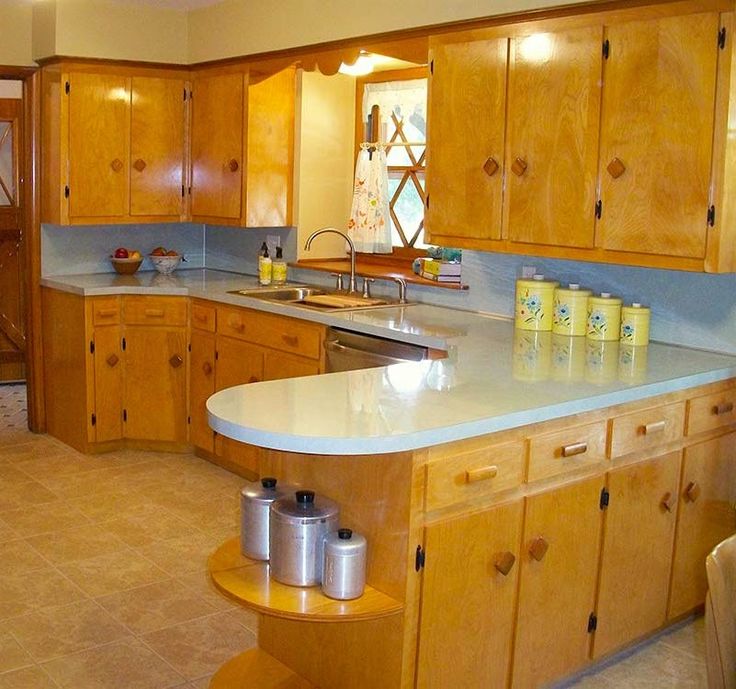

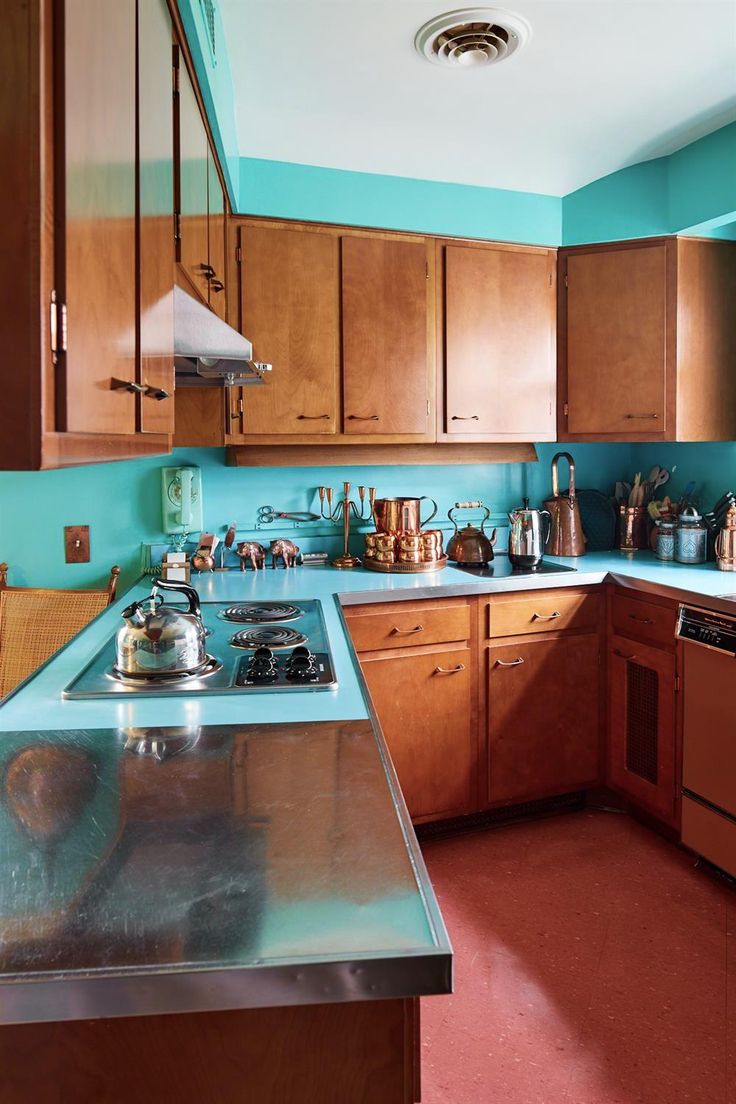
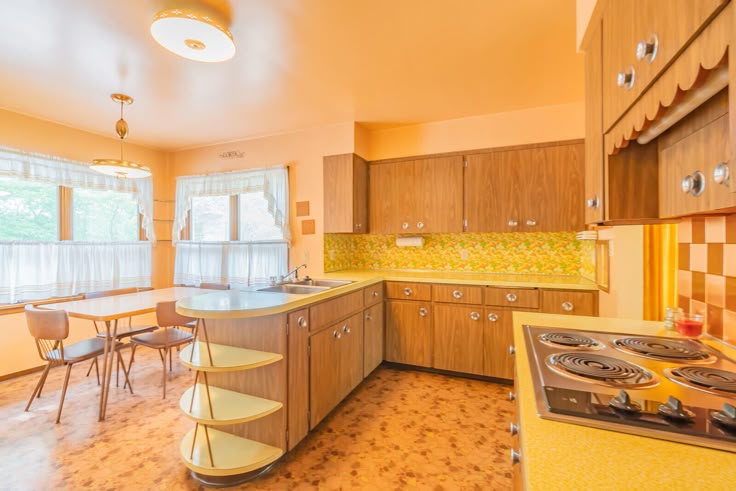
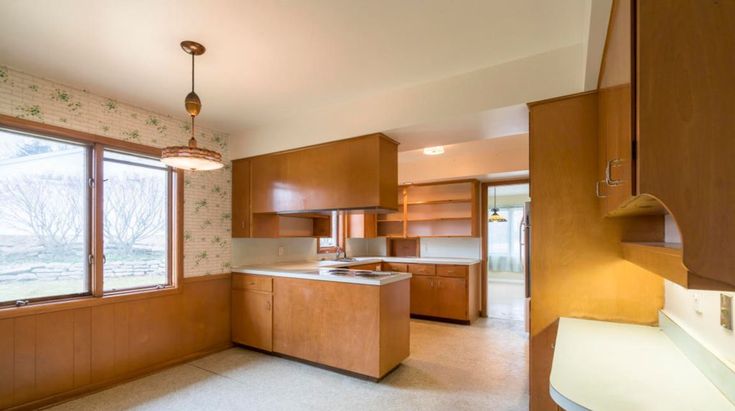
In the most modernist of mid-century homes like this Albert Frey house from 1955 you might see full overlay doors OR inset doors like these for a very sleek wood panel wall style of built ins:

Those mid-century kitchen cabinet questions and YOU
The choices you’ll make for your home depend on your budget – cabinets can be pricy and you’ll want to fit them into the price range that is feasible for you. And they’ll depend on how much you are trying to make your home feel like a literal time capsule vs hoping to create an update that still keeps a timeless yet modern vibe. Let’s go through them in order (or scroll to the podcast transcript to find scenarios for several types of remodel)
Construction Type
Pre-manufactured cabinets are a great choices for an avid DIY-er. You can create a perfectly acceptable mid mod style updated kitchen from IKEA cabinet boxes and semi custom door and drawer fronts.
If you’re working with a general contractor on your remodel, they will likely have a prefered cabinet shop that they like to coordinate with for the construction (and delivery and install) of built ins. This means you’ll likely be going custom or semi custom for cabinets.
Chat with any GCs right away to make sure you’re on the same page about the built in construction type you want to use.
Cabinet box type
These come in two general flavors: European and “Traditional” which means face framed. Basically, when you open a door do you see the edge of the side wall of the cabinet or do you see a finished framing piece covering that up.
Either can be correct for a mid-century kitchen cabinet. And depending on your door overlay type you won’t even see the difference when everything is closed up. Some cabinet shops will have a specialty or preference here so this choice may be made in the one above.
This is going to matter most if you want a vintage style cabinet with a partial overlay door. That needs a face frame to reveal.
Door type
Door type comes down to how much of the cabinet box behind is revealed by the closed door. You can choose full overlay – none of it shows. Or partial overlay, which reveals a bit of the face frame behind it. This can allow you to have both wood grain cabinet doors and a colored framing around each one.
The third door/drawer type, inset, is less common in mid-century built ins. You’ll only see it in a modernist or minimalist setup like the Frey kitchen (above) or in a specialty cabinet shop like Kerf Design which specializes in cabinets that reveal the edges of their plywood frames as a design feature. (They are gorgeous. Go check them out here. )
Door style
Slab style doors are the only right choice for a mid mod house. Take the W and let this be an easy choice!
What it’s made of
Again, youve got options. There certainly were painted cabinets in the mid-century era and this can be a budget friendly option. But it also runs the risk of flipping into trendy. And part of the beauty of a flat slab doors and drawers lies in the wood grain. So I strongly recommend you consider wood.
When you do … don’t be afraid to say yes to veneer. This is a perfectly mid-century choice. And in some cases it’s the only way to get the gorgeous topographic line wood grain you’re looking for. Pull some samples of great vintage furniture to show your cabinet team!
Other details for your mid-century kitchen cabinet choices
Don’t forget about what happens top and bottom (where the cabinets meet the floor and ceiling. It should be simple!
SAY NO TO CROWN MOLDING.
If you need a finish piece of trim to connect the built ins to the wall, keep it a simple rectangular bit of parting stop.
The kick plate can be a place to flash some color, keep things sleek by continuing the wood grain of the cabinets or even to run the flooring material up a corner.
Can you keep some of your original mid-century kitchen cabinet array?
I love this example by my friend in Boise, Jessica Luque, who was able to preserve the original mid-century uppers in this kitchen to add authenticity to a set of new lower cabinets in this lovely remodel.
Resources
- Style Guide Workbook start here to simplify your life!
- More than a Mood Board fun 2 hour design clinic
- Mid-Century Furniture blog post for excellent inspo
- Want us to create your mid-century master plan? Apply here (https://midmod-midwest.com/services) to get on my calendar for a Discovery Call!
- Get Ready to Remodel (https://midmod-midwest.com/ready) , my course that teaches you to DIY a great plan for your mid mod remodel!
- Schedule a 30-minute Zoom consult (https://midmod-midwest.com/call) with me. We’ll dig into an issue or do a comprehensive mid century house audit.
And you can always…
- Join us in the Facebook Community for Mid Mod Remodel
- Find me on Instagram:@midmodmidwest
- Find the podcast on Instagram: @midmodremodelpodcast
Read the Full Episode Transcript
To make timeless choices right for you and your house when you replace mid-century kitchen cabinet s you’ll need to answer these five questions. you’ll be locking in your cabinet manufacturing type, the cabinet box type, the door and drawer type, the door and drawer style – that’s a different question, and what its all made of.
I recently helped a client answer these questions and realized that while all of the answers were instantly obvious to me, they’re an overwhelming mystery to most people facing them for the first time. So let’s start by cutting a long episode short. The answer to the fourth question the right door and drawer style for mid-century kitchen cabinet s is flat panel or slab every single time for the rest of it, though, there are pros and cons options you’ll want to consider, and we’ll get into all of them today.
Hey there. Welcome back to mid mod remodel. This is the show about updating MCM homes, helping you match your mid-century home to your modern life. I’m your host, Della Hansmann, architect and mid-century ranch enthusiast. You’re listening to Episode 2111
so we’re talking about your mid-century kitchen cabinets. Now, not every remodel involves updating, backdating, improving, redoing the kitchen, but it is at the top of the list for projects I work on with my clients and ready to remodel students.
Why? Well, specifically, kitchens and mid-century houses come to the top of our to do list for two reasons, for one of two reasons, really, but sometimes for both. The first reason is that, as I’ve talked about many times, mid-century, houses are a pretty good match for the way we live our lives today, but the kitchen specifically embodies a lot of lifestyle choices and values that we have shifted away from.
And most kitchens were originally conceived of as a place for one adult that is mom in a household to create food, to take care of household tasks, to do any light office household office work, to keep a light eye on kids and family activities happening around the house, and then to deliver food out of the kitchen to all the other people who will consume it, then to come back into the kitchen and wash up after herself.
That this the system still works for some households that one individual adult is in charge of food prep. It’s not necessarily going to be mom anymore, but there are still household clients that I’ve worked with many times where one person is the cook and they like to be the sole owner of their domain. They want to be left alone in there. And for people like that, a mid-century layout of a kitchen can still work just great.
They also work well for single people. I like the layout of my mid-century kitchen just fine, but for households where two people cook collaboratively, or where people want to get their kids encouraged to be involved in cooking activities, or just where people are more regularly guests in the house and want to socialize in the kitchen, a mid-century kitchen layout is often quite constricting.
The other reason that mid-century kitchen cabinet s need replacing, that kitchens need remodeling is because they were remodeling badly in the past. So we may be dealing with the original 1950s or 60s layout, and then cabinetry could be coming to the end of its useful light after 75 years.
But sometimes we’re dealing with an 80s kitchen, a 90s kitchen, a 2000s kitchen, or something that was just flipped before you bought the house, and in that case, if it’s more than five or 10 years old, it may be in poor quality and already starting to fail because a lot of replacement kitchens were built not to last, or because it doesn’t match the style era of the mid-century house, and we’re remodeling for esthetic reasons.
Now, I said it’s one or the other those two reasons, but sometimes it’s both because, as I have ranted about on the podcast so many times, the worst, the deepest, dramatic irony, the most unfortunate situation, is that when someone pays for a remodel back in the 80s, 90s, 2000s or five minutes ago, they let themselves have the worst of both worlds, and they chose to make a trendy time dated update to their house, which is now out of date, and they also did not take advantage of the opportunity to modernize or improve or make more specific the layout.
So we might have an out of date layout from the original kitchen and also a dated esthetic that doesn’t match the bones of the house. Worst case scenario, we’re going to spend a lot of time today talking about mid-century kitchen cabinet s and what to do if you’re making brand new choices for an update of your mid-century kitchen cabinet s or any other part of the house, really, this does not have to be the kitchen.
This is just as true for the bathroom vanity built ins, for built ins in the storage hallways or in public spaces, in bedrooms, in basements. The same information about grain, about construction, about door type hardware will apply. Before we get into that, let’s, oh, let’s have a tip of the week. Okay, so I’m going to pull from, again, what I teach all of my students inside of my ready to remodel program, which is going to be really relevant for today, which is when you’re thinking about how to make simple choices how to bring down your level of overwhelm from literally everything available in the world is somewhat accessible to you today.
You can order anything from the internet. You can have any type of custom cabinet made. How on earth do you focus that down and choose just one object for each? Individual part of your house. Well, you can cut down on that overwhelm significantly by using the style guide system overall for your whole house. And if you’re focusing on one room specifically, you can start from a single style sheet for one space.
Now this is a method that I teach to my ready to remodel students. I prepare style sheets for my master plan clients, and I’ve actually also taught this separately in a little two hour workshop. If you’re curious about it, it is entitled more than a mood board, the style guide system you need for a stress free remodel. And I walk you through how to take yourself from everything on the Internet into Pinterest, gathering ideas, how to focus that and boil it down, how to apply your personal choices and the reality of your house, and then pull together style sheets for specific rooms in your house.
But the ultimate part of that is to is to look at one room and to think about it as its sort of definitive major materials. What is the wall finish like? What is the wood grain that’s happening in the room? What are, ideally, just one or two metals that are happening in that room? What soft furnishings are going on in there, and how do they all neatly fit together? What’s happening on the floor depending on the type of room, a bedroom might be relatively simple. A bathroom or kitchen has a lot more options.
Flooring, tile, wall tile, different types of light fixtures. It’s got metal and plumbing appliances and fixtures and things like that. But the more or less complicated it is, you want to see the whole room together. This, by the way, putting it all into a digital document of a style sheet is just step one before you get actual samples and actually hold them up next to each other in reality, in the daylight of your space to make sure that two colors that looked good next to each other online still look good to each other in real life, nothing takes the place of actual samples.
But yet again, let me be clear, I do not recommend that you begin your process of choice by finding physical samples and assembling a collection of them. That is a route, a speed trip, a shortcut to overwhelm you want to start go in the right order. Start by gathering your inspiration. Focus it down into a style guide. Focus that into a style sheet. And then, when you’ve got that room visualized digitally, put together your real world samples and track them down.
Okay, so if you’re curious about the more than a mood board workshop or the style guide system in general, I’ll put links to our ready to remodel program, but also to that two hour workshop on the show notes page for today, by the way, find the show notes for this. I’m going to show some visual references to cabinet, door and drawer types and links and helpful anything else you need, you’ll find that today at mid mod midwest.com/ 2111
All right, let’s get into it. As I was putting this episode together, thinking about the categories of information that I wanted to make sure to cover, I did a little Googling, and I came across an article that, you know what I am going to name check it. This is a bit mean, but it was so irritating to me. I found a remodelista article in their remodeling 101 category with the title A Guide to the only six kitchen cabinet styles you need to know.
And it just I was struck by what complete nonsense their category of kitchen cabinet styles was because it was such a mix of styles and types that were basically trends. The six that they had were shaker, glass, front, bead board, flat front, plywood and natural or finished. These aren’t styles. They aren’t even, you know what? I don’t even know that they’re trends. They’re certainly some options, but some of them are shapes, some are materials, some are finished types. Some are broad categories of esthetic.
So anyway, there are certainly options you could choose, but I wouldn’t recommend them. I mean, they weren’t purporting to be from mid-century houses. They were just declaring, generally, for everyone on the internet, this was the only thing you needed to begin sitter, which also drives me up the wall, because the first thing you need to know is, what’s your style? What’s the house you’re working on? Are you trying to make mid-century choices, or cottage choices, or Victorian, or are you doing something completely modern?
All of which are fine, but that is important to know before you start picking out the only six kitchen cabinet styles. Anyway, I’m annoyed, so I am going to strongly urge you that the only quote style, unquote you really need to consider is a slab or a flat style. That’s a style. It’s a door style, and we will encompass that. But right here at the top, I’m going to give you the questions that you have come here for the five questions you are going to need to answer to focus in your kitchen cabinet choice, if you’re doing a replacement kitchen, are the construction type that is premanufactured versus custom.
There’s also semi-custom in there, the cabinet box type, European or traditional, face frame door overlay type. So. So inset, partial overlay, or full overlay. The style. You have many options, but I’m telling you, you have one option for a mid-century house. It’s a slab style. That’s that is our choice. That’s the one. I’m not going to give you possibilities here. I’m just going to say universally, it should be slab. We’ll get into this more later.
And then the material painted solid veneer. The subcategory of that is, if it’s veneer, is it rotary Rift or flat veneer? In any case, it had better be grain matched. There are some other factors the hinge types, which are somewhat determined by the door type. So you can kind of chicken or egg that one. Are you looking for concealed hardware? This is also known as European or cup hinges. Do you want it to be semi concealed where you don’t see the attachment plates, but you see the little barrel of the hinge or surface mounted, which happens in some vintage-y mid-century kitchen types.
There are more options, but those are the three big categories that you’re going to see. We’ll also tap what happens top or bottom, where the cabinet meets the floor or the ceiling. General rules are just say no to any kind of crown molding or ornate connection between the top of the cabinet and the ceiling, or a little frilly top crowns around the top of cabinet that does not meet the ceiling and probably say no to dropped soffits as well.
We will not be getting deeply into handles and pulls that is a whole other episode, likewise functionality doors versus drawers. But in short, I’ll tell you that I always think anywhere you could put a drawer, it’s a good idea to put a drawer. So all of these categories, these five major things we want to think about, construction type, cabinet, box type, door type, that is overlay inside or partial the style, its slab, the material, painted solid veneer.
These are going to come up for any type of built in that you have in your house. You’re going to need to make these choices now. Other choices you make in your process may limit your options. It’s not necessarily a bad thing. They may sort of direct you towards one thing or another. For example, the type of contractor you work with, whether they’re sort of a one man band, that type of person is more likely to be happy to work with you on pre manufactured or even IKEA cabinet boxes, versus many larger sometimes a one stop shop general contractor will have their own in house cabinet folks, and often a medium sized general contractor will have a cabinet maker that they prefer to work with.
That cabinet maker might specialize, for example, only in European style cabinets, or only in traditional style cabinets, so that can limit what your possibilities are. You may if you feel really strongly about one of these categories of decision, use that to choose who you work with on an entire project.
Again, the chicken or the egg here, what feels most important to you, what decisions you lock in first, can then lead you to other decisions. And there’s not a right way or a wrong way to make that decision tree, but let’s talk about how these options can come up. Now that we’ve thought about all these categories, I’m of course going to take us on a little side quest into vintage mid-century history.
So in the vintage mid-century kitchen, the earliest mid-century kitchens weren’t anything we’re talking about today. They were likely metal. The sort of proto mid-century, kitchen was a metal premanufactured set. So if you look in the ads for kitchen appliances, fixtures and finishes in the 30s and 40s, or, for example, the Kohler catalog of sinks and plumbing appliances going right up into the 50s, you’re gonna see metal cabinets, and they can be absolutely fabulous.
I have just recorded an interview that will be an episode in a few weeks with Susan Halla of make it mid-century. And the main thing we’re talking about in that conversation is that she’s just moved house. She’s finished a house hunt and will be moving at the time we recorded anyway. And we talk about how the sort of unicorn kitchen. The house she’s moving into is great in almost every respect, but it has a remodeled kitchen, and her goal as a mid-century purist, as a vintage lover, is to recreate an original, authentic mid-century kitchen.
The gold standard for that might be to find a set of metal kitchen cabinets out there, and they are around because they’re so sturdy, they’re so sort of forever materials that they could be taken out of a house and sold, or they could be stored in a barn for years, for decades, and then cleaned up, repainted, or re powder coated and good to go again. I’ll put a couple of images of mid-century metal cabinets into the show notes page, so how charming these can be but for the purposes of today’s episode, we’re talking about what you can do now and what you’re likely to choose as you move forward.
We’re probably talking about wood doors, wood comb boxes. We’re not talking about metal systems in this place. The other really common choice for. What you’ll find in original mid-century home that has its originally installed cabinets are a set of built in place wooden cabinets. Now these are going to be very solid. They were built at the same time of the house, so they’re built out of the same old growth, densely grained pine that’s holding up the structure of most mid-century homes.
They’re dimensionally stable. They often have plywood doors that are beautiful in their grain quality, often grain matched. And the fact that they’re plywood does not mean they are not worth keeping. Unfortunately, this kind of original kitchen system is very hard to salvage if you can’t keep working with it, because they were built into the house. Unlike modern kitchens, they weren’t manufactured in a factory as individual boxes delivered to site and installed. They were constructed inside the house by the original builders.
So if you’re in the position of having this type of kitchen, you don’t necessarily need to get rid of it. You may need to replace it, and if you do, you can’t really take it away and give it to someone else. All that can be salvaged from an original kitchen like this would be the doors, the drawers, the hardware. So I do want to begin with an appeal to keep what you have in your mid-century kitchen, if it’s working at all.
Oh, my goodness. I was just on a field measure visit for one of my upcoming master plan projects, and I experienced the most charming time capsule, house so filled with the most exquisite and thoughtful built ins all over the house, a hallway in the bedroom area with a long line of sort of built in walk in closet with doors and drawers of every convenience utility, a Little airing drawer with a built in vent, a laundry basket, a walk in cedar closet that must smell nearly as fresh today as it did when it was built, and then a kitchen and a mud room with every conceivable shape and size of storage.
The hardware was in perfect condition. All the little spring loaded roller catches that grab and snug the doors closed perfectly released them, and then just a pull out cutting board in multiple locations, and the most smoothly opening, well balanced Lazy Susan corner, very fully loaded with stuff.
What else? Oh my gosh, it had this great working peninsula dividing the kitchen from the dinette, and under it in the kick plate, there was a little device with a foot kick vacuum switch so you could sweep the kitchen and take all the detritus over to this little opening, and then activate the switch with your toe, and it would lightly vacuum and suck in all of your dust and crumbs and things down into a crawl space under the house.
Actually, I don’t know. I couldn’t see that there was a container for it. I think they just went into the dirt of the crawl space. But bottom line, as I was going around this house, photographing, measuring, documenting it, preparing for a master plan, I was falling in love. And fortunately, it’s quite possibly, it’s quite possible that for this house, for this kitchen, we will keep a lot of it exactly as is intact.
This house doesn’t need a major kitchen change in other kitchens, in other cases, if the cabinets are not in such great shape, the kitchen might not be as Fauci or as well laid out as this one, but sometimes, for a family that appreciates vintage charm and doesn’t want to spend their entire budget on new kitchen cabinets, it can still be worth working with what you have. You might keep some of your kitchen cabinets and augment them with a few new ones that coordinate or contrast with them in an interesting way.
You might take out a peninsula and replace it with an island but keep the main L of built ins or mix and match between some existing storage and some new I have another master plan project on the boards right now, which is going to be making a choice like that. It’s a snug mid-century Cape Cod style cottage with its original kitchen in pretty good shape. And we are going to think about finding the original door drawer hardware to put back, maybe refinishing the cabinet doors and certainly adding storage. But we don’t need to tear out and replace that kitchen.
This is going to have two advantages for them. One, it’ll give them a brushed up time capsule esthetic which suits their family style. And two, it will massively save their remodeling dollars to spend in other places around the house. This is sometimes the right choice in my own kitchen, the combination of how charming I find it and how much it does work pretty well for me as a single woman, mostly cooking alone, and the way I hate to think of how I would have to put all of that original woodwork into a dumpster if I changed it, and how much I adore the amber Shellac and original pine plywood doors and drawers I have throughout my house means I will never substantially alter the layout of that kitchen.
But I have modified the way that it works by adding in a free standing Butcher Block Island and additional storage. And I have thoughts about how I can even more carefully repurpose and reorient bits of that kitchen in the future, if I ever feel like getting really DIY ish again, the thing I want us to just appreciate is that not every kitchen in every mid-century. House needs to be picked up and tossed into a landfill.
However, the purpose of this episode today, if you’re Googling to find this, if you’re tuning in specifically because you want to know the right answers to the mid-century kitchen cabinet questions, it’s probably because you are in the position of replacing a kitchen, either because you don’t have your original mid-century kitchen due to a previous remodel, or because maintenance failures of the past or major layout changes just mean you need to start from scratch.
Now there are a lot of silver linings to a start from scratch kitchen remodel. If you are removing all of the original kitchen cabinets and replacement cabinets, you’re getting down to the walls, which means you can open them up and you can update, as you may be required to do your electricity system. You can get outlets spaced at four feet per code. You can update circuitry so you’ve got less of a load on what happens when you run the microwave and some other appliance at the same time is it can be a problem in a totally Time Capsule kitchen.
You can add insulation to exterior walls, you can create more sound privacy within the space, and you can update the layout to be more effective for your chosen kitchen lifestyle and modern life in general. You also get the benefit and the challenge of answering those mid-century kitchen cabinet questions and getting the mid-century replacement kitchen cabinet right or wrong can make a big difference.
So let’s get into the substance of this episode. What I want to talk to you about is how to answer the mid-century kitchen cabinet questions that you will get as you talk to either a general contractor or the person who runs a shop at a cabinet building establishment. Now you have a lot of options in terms of pricing, in terms of how much or little your cabinets are premanufactured or custom made, what their structure might be. There are a lot of ways to be right, but one choice is pretty fundamentally preset for a mid-century house, and that is that you are going to want to choose slab cabinet doors. This is effectively the only correct choice I’ve thought about this.
Am I being too persnickety? Are there other options? I mean, sure, there are always exceptions to the rule. But if you want to create a timeless choice for your mid-century kitchen cabinet s, if you want to ensure that you’re not leaning into a trend, that you’re not putting a timestamp on your kitchen the only correct answer to the mid-century kitchen cabinet question about door types, Styles is slab. Why?
Because in the mid-century era, we are at the crossing point of natural materials, but also the Machine Age of materials. So we want to show off our wood grain in beautiful sheets of old growth veneer, but we also needed to show off in regular, panelized manners. And it’s just they leaning into the power of technology, of what was available in the time of the mid-century era, they did not need to use the construction techniques which had been necessary in the past to stabilize a door against the swell and shrinkage of humidity and seasonal structure temperatures. Now that we’re living in an age of plywood, we just don’t need to do that anymore.
So I want to make a slight diversion into Shaker Cabinet Doors, because I spend a lot of time telling people on the internet not to put shaker cabinets into mid-century houses. And as I say, slab cabinets are your style choice. That’s the answer, and I stand by it, but there’s nothing actually wrong about a shaker style cabinet door in general, the history of shaker crafted furniture and architecture design in general is fascinating and not dissimilar in ethos from the core of the mid-century era. From a certain point of view, they’re both interested in beautiful materials. They’re both interested in functionality and livability, rather than ornateness.
But the shaker era, the shaker religion, to be clear, was founded on an ethos of perfectionism to bring you closer to God, minimalism, simplicity and function. It’s beautiful, it’s careful. They had this whole wonderful thing about each piece of furniture or woodworking that was created in the shaker tradition was basically a work of art, but would never be signed, because it would be sort of getting away from the simplest.
You know, it is a gift to be simple, the simple origins, the humbleness of life to put your name on something now that that craft celebrates a hand assembled, almost Luddite, total perfection. It goes hand in glove with actual farmhouse house or a farmhouse style cottage, if that is your flavor, if you live in a 1930s building shaker style is going to be right up your alley. But a mid-century ranch or a mid-century modern house asks for something different, a. Again, we’re returning to the machine age, or we’re entering it.
This is about veneer. It’s about plywood. It’s about standardized materials, and that is how we are celebrating the organic, natural material, wood, grain. It’s happening in the context of plywood and of veneer. Now do not be afraid of veneer for your mid-century kitchen cabinet choices. This trips up a lot of people. People get afraid of veneer. They’re afraid it’s going to rip; it’s going to peel off. They’re afraid that it’s going to chip or be only paper thin.
Veneer doesn’t mean a picture printed layer. It means a thin but substantial slice of wood grain that has been removed from a wood in one of several manners. We’re going to talk about rift sawn versus quarter sawn versus rotary veneer. But whatever the however that veneer is harvested, it’s making an efficient use of a good quality wood and applying it over something that is going to add stability and strength.
So I highly recommend veneer cabinet doors to my clients. In fact, it is the only way you’re going to get the beautiful green continuity that is a hallmark of a good mid-century cabinet wall of built ins. And so if it worries you, I want to point you back to the episode where I did a little pep talk combating misapprehensions about veneer, just earlier this year, in Episode 2012 I believe on mid-century furniture that you can aspire to, you’ll want to go check that out, and I’ll talk to you a little bit more about how great veneer is and how it is the hallmark of mid-century choices.
So as we get into these mid-century kitchen cabinet questions, you are going to have to answer the specific questions you’ll get when you nail down your cabinet choices. Now this is not what you start with in a master plan process. We don’t begin from the kitchen cabinets. We begin from space planning. We begin from the lifestyle you want to live in your house. We begin from the house that you have. We begin from your style guide choices, and we begin from the options that you start to weigh of how much or how little you’re going to change about the house in any specific area.
This might come down to pros and cons of preserving original built ins that you have and working around them or needing to replace them, because you’re making major, dramatic changes to your layout. Once you get to the place of answering the mid-century kitchen cabinet questions, you’re going to need to nail some things down. So let’s talk about that place. Before you even get to have a conversation with a cabinet builder, you will be making a decision, probably about whether you’re choosing custom cabinets or premanufactured cabinets.
Now, this may be a conversation you have with your general contractor, or if you already know that you want, for example, for budget reasons or because it seems practical to you to do an Ikea kitchen, you might make that decision before you ever speak to general contractors, because some general contractors are going to feel comfortable with helping you assemble and install an IKEA and a semi-custom kitchen, and others are going to refuse to work with that that’s not their area. They don’t want to mess with it often. That’s because a contractor of that scale will subcontract the entire cabinet project to a kitchen cabinet shop.
Who will the what matters to the GC is not who makes it and how, but the fact that the person who makes it will come, measure, document, and finally install so that they can hand off the entire scope of work of cabinets and built ins to another person when they are doing something with a kitchen from Ikea, it’s a lot more internal management if you are DIY, and you can absorb that energy and cost yourself and save in dollars, but if your contractor is doing it, they may just feel like it’s not worth their bother.
So you’ll find that a lot of GCS will or will not by policy, work with a premanufactured, particularly with an Ikea kitchen. That might be a question you want to answer before you choose your general contractor. So kitchen cabinet Question number one, premanufactured, or custom, or semi-custom, somewhere in the middle, is maybe going to determine who your general contractor is. This is a big question. There is, by the way, nothing wrong with an Ikea kitchen in a mid-century remodel. It’s not the authentic, original choice for an American house, but it’s coming out of the European modernist tradition that was doing the same things across the pond and has a lot of the same ethos behind it.
These two sort of cousin streams of thought work nicely together, so you can actually get all of the advantage of the internal organizational system provided by IKEA and their structure to create a budget friendly and DIY friendly kitchen system and then have semi-custom door and drawer and panels made for that kitchen cabinet set that go ahead. Yeah, for years I’ve had clients choose to work with the company, semi handmade, and they have a lovely walnut veneer set. They do grain matching, and it’s very nicely put together, and it’s absolutely DIY friendly to anyone who just has time and patience.
It doesn’t require a huge skill set to put together a kitchen from those two components, IKEA boxes and semi handmade door to door fronts. But if you choose to go with custom, you’ve answered question number one, I want custom cabinets, then you’re going to start talking with either a GC or their cabinet shop and starting to place the order. The origin for this episode, by the way, is a conversation that I had on site on behalf of a client whose remodel is in process right now.
Now I don’t. Often, I don’t, yeah, I would say I don’t always. I don’t often work on site or provide any kind of construction administration services for my master plan clients, the Master Plan package that I provide concludes before the handoff to a contractor. But often my clients will stay in touch after their master plan is concluded, and I’m always happy to provide advice as needed on anything from a few more drawings for built ins or answering questions that have come up in the demolition or when the contractor has suggestions, the client wants to make sure that they seem mid-century appropriate, that they are good to interpret into the master plan.
Sometimes I help with selection of finishes or fixtures continuing beyond the style guide process, just smoothing along whatever’s necessary. If you’re curious about this, I have talked at length about that process in episode from 1207 from couple years ago, and that’ll walk you through some of the some of the ways that beyond a master plan mid mountain Midwest could help you continue to make thorough decisions for your project. In this particular project, I’ve been much more hands on at the request of the client, because they’re they started construction managing off site in a big transition from another state, and their process is very fast tracked.
So I’ve been with them often, and I was there with them on site on the day when we met with the cabinet provider, we looked at the sketches that had been included in their master plan package, walked the space and addressed everywhere in the house that would need some built ins, quite a few places, and then banged through this list of questions. So some of these were pre-established based on who we were talking to at the time. We were already talking to a custom cabinet provider.
So we’ve already decided between premanufactured and custom cabinets. And in fact, this is the preferred cabinet maker of the GC, who specializes only in European style cabinets. So that gets us into our second question of, what is the style of the boxes, the containers of the cabinets, the two major questions you’re going to face here in terms of what is the cabinet construction type will be a European style or a face frame, or traditional style. European style is just a box minus a front. It has two sides, a top and a bottom, and the little flat edges at the front are just the thickness of the walls themselves.
A face frame cabinet has an extra piece mounted to the front that sort of sits on and stabilizes the whole thing. And it might be nicely finished. Those backing pieces would be maybe plywood or particle board in a lower quality unit, and the front would be a hardwood or wrapped in a veneer or a melamine finish. There is also one further variation of cabinet box style, and that is a kerf style, where you expose the edge of the European box, a European style cabinet fully covers those edges. But one company in particular, kerf, K, E, R, F, is maybe the by word for this.
There’s also ply Kia. There are a bunch of plywood based cabinet companies, and they actually not only reveal when the cabinet is open, the interior edges of the cabinet frame, but they show you, when the cabinet doors are closed, the pretty plywood line work of the veneers all pressed together. If you’re curious about kerf cabinet kitchens, I have had a ready to remodel student. Go ahead and order and have one of those installed. It is absolutely chef’s kiss gorgeous.
They are also not inexpensive, so go and drool over the kerf website and imagine what you’d like. But this is not something you’re going to get a local custom cabinet maker to manufacture for you. It is a highly skilled endeavor that requires kind of a specialist organization that does just that all day, every day, like curve does. So you’re probably going to be choosing between a European cabinet box and an American or traditional face frame cabinet. By the way, IKEA cabinets are all a European cabinet box type.
So we’ve got our first two questions. How is it manufactured? How. And what is the cabinet box type, and we have talked a little bit about door styles, this might actually be the place where let’s run some scenarios. So because the way that you choose a door full overlay, partial overlay, is going to depend a little bit or inset is going to depend a little bit on all the other choices you’re making on your style guide, on your personal mid-century style.
So your mid-century kitchen cabinet questions are going to be answered one of several ways, depending on which type of home updater, back dater you are. So let’s say you are repairing or recreating a vintage kitchen in a time capsule house, or perhaps recreating something that feels like a time capsule anywhere doesn’t have to be a mid-century kitchen cabinet, by the way.
It might be a bathroom cabinet or a living room built in, but if you are looking at this kind of vintage recreation, you’re looking for custom cabinets, or site built cabinets, as we talked about at the beginning, in the original era, these houses all had their cabinets built into them, and that might be what you choose to do as well.
You’ll want to look at some original pieces, or if you can get your hand on a mid-century era built in construction manual. A couple of years ago, I happened to pick up Mario Dal Fabbro How to Make Built-In Furniture published in ooh, I’m flipping through it right now. Let’s see. Ah, the 50s. This is actually published in Europe.
Oh, you know what? Originally published 55 this one is published in Great Britain in 62 the copy I got came to me from England. And it’s interesting, because it’s absolutely the kind of home DIY style that was adding the kind of built ins you would do if you were going to finish your own basement at the time. It is, however, all its examples are European style boxes, because while I think Mario Dal Fabbro was working in America, that was my understanding, but maybe I’m incorrect.
But you know, he was born in Italy, and he’s thinking about a European style as simpler and more correct. But you’ll look at how things are done in the house. If any existing pieces of furniture you want to copy them, you might visit a neighbor’s house who has more original stuff? So let’s answer our five questions. So number one is, this is absolutely custom or built on site. So our cabinet box type, in this case, would be probably a traditional or a face frame cabinet box type, although, like it said, it might be constructed out of a guide like Mario Dal Fabbro, the door type will be, if it is a face frame cabinet, partial overlay.
If you look at a traditional mid-century kitchen, you can see the sort of, often white painted frame around the doors, and then the doors themselves. You decide how much, but some amount of the frame of the cabinets would be visible this door style. Door style question is easy; the answer is slab. It is always slab. But to put a little more detail on that, in a mid-century traditional vintage Time Capsule house, it’s going to be plywood. It’s going to be a nice, warm color finish. Probably back in the day, it would have been pine.
These days, you’d look for a maple plywood, possibly a birch, and you’d put a warm urethane stain on it, probably rather than amber Shellac. You would also though to hit that vintage style rather than a straight square cut edge on the plywood, you would be routing the edges so there’s a slightly curving profile, which actually exposes a few of the ply elements of the plywood. It’s more gentle on the fingers. And you’d be looking for probably a partially exposed hinge, depending on how you’re making this work. And you’d be looking for vintage or vintage reproduction hardware to go along with that.
Then the last question is, what is the finish did this is, this is going to be exposed by wood. That’s our slab, and that’s our finish. But going beyond that, remember, we’re looking for the sort of mid-century wood grain. It’s going to be a warm stain, warm rather than cool. In every case, what it’s made of. It could be walnut, if you want, but it’s probably going to be a lighter colored wood. And when you’re thinking of what specific species, there is not one right answer for the species, and there’s certainly, as many people have asked me, for unfortunately, there is not one product and stain number, type, exact specification for the appropriate finish of mid-century wood.
But for mid-century wood, we’re looking for something with not too much contrast between the lightest part of the grain and the darkest part of the grain, and we’re looking for a warm overall tone. Now, if you are working with an existing Time Capsule house, you’re trying to match a mid-century Captain cabinet detail that’s in your house, or recreate one, you’re going to want to pull from the language of those existing choices.
So. Yeah, however, now let’s run a different scenario. Now you’re talking about a mid mod fusion update on your home. Perhaps you’re replacing a horrible 80s or 90s kitchen, so you’re starting from scratch, and you’re a DIY er, or you want to self-manage the process, so you want a pretty easy to work with system. In this case, I would recommend that for your construction type. You choose premanufactured, choose IKEA. So that premanufactured choice directs us right to our we already have our cabinet box type. It is European style boxes, or type boxes, which again, creates a cascade of choices that comes from that.
That means you’re going to choose full overlaid doors, because that’s the type of doors that go with a European system. It means you’re going to go with the IKEA hinge system, which is a cup hinge. If you want to keep your life simple, you are not going to try to custom manufacture doors and drawers if you want to keep your house mid-century, but you’re probably not going to go with the IKEA provided options of doors and drawers. In a pinch, you could if you needed to go with IKEA for speed of construction or maximum simplicity, I would say go with a white rather than any of the IKEA Fauci finish wood or veneer finish wood.
It’s not quite going to hit the mid-century vibe, so you’d go with white. And I would recommend that their mid-range white finished door. I believe it’s the VEDDINGE line is perfectly acceptable, as well as long as you can get in a bunch of other mid-century toned wood somewhere else in the house, a panel wall, butcher block element somewhere else to make the best of an Ikea cabinet system in a vintage a mid-century fusion update.
I would recommend for your mid-century kitchen cabinet choice, you cover the boxes from IKEA in a semi-custom wood, door, drawer and panel finish. I’ve had several customers and clients and students over the years go with the semi handmade product line, but there are also some others that now exist on the market. It’s not just one option anymore, but what you would choose, of course, is a matched wood grain. Semi handmade has a lovely walnut line that gives you grain match across the panels in a beautiful way.
This is going to be perfectly acceptable. It’s not going to look like it was original to the house, but it’s going to feel very in line with the house. And when you make the other choices appropriately. You choose the right kind of tile flooring, hardware, handles, light fixtures, you’re going to get an overall esthetic that works very well in your mid-century house. So you’ve got a great line of choices for your mid-century kitchen cabinet s.
Let’s run these five questions for one more scenario. Now we’re in a situation where you’re doing a full update with custom cabinets, because that’s what’s being provided or recommended to you by the general contractor you’ve already chosen to work with. And also, because you wanted to go custom, you want to have a little more have a little more control over exactly how everything’s going to go. This is a great idea. It’s going to allow you to do some more open shelving, if you’d like, fit in a custom made built in bench. It’s got a lot of pros.
So our five questions, construction type. This is going to be custom. It is predetermined by your general contractor choice your cabinet box type. Now this one is maybe a choice you won’t make yourself. It’s going to depend on what is the default or the best talented option available from that cabinet providing company. Likely it’s going to be face frame, but it might be that this cabinet company specializes in European cabinets.
And if so, that’s fine. Roll with it for the door type, because your taste in this scenario is more modern than mid-century vintage. You’re going to choose full overlay cabinet doors and drawers regardless of the cabinet box type. So it’s going to create a monolithic wall. When everything is closed and you’ve got your beautiful grain match going on, it will feel like a wood panel wall with some handles in it, a really beautiful, sleek, lovely esthetic.
So door style, okay, we’re going back to question four. What’s your door style? Say it with me now. It is slab style. It is not shaker. It is not modern shaker, a slim shaker. It is not raised. It is not panel, it is slab. Okay, great. Your door material. Now, what makes your door material is, again, as I said, not a particular wood grain or species, and there’s not a particular type of stain that’s correct for your house you’re going to be guided by if there’s any original woodwork in the house that you are preserving in this scenario, and you’re going to be guided by what are the available options from your cabinet company.
Now this they may have several options that they do. They may have a range of species that they get from a supplier that they like, and a bunch of different ways that they can finish them. That’s great. They may, in my opinion, somewhat unhelpfully, tell you, Oh, we do anything. What do you want?
So in that case, you do want to see visual examples, you will start by giving them a visual example, and then you will ask for something back. So you. Don’t you do not need a specific species, and it may be possible to really control costs by you know, if you choose walnut, it’s going to become more expensive if you choose something more like birch or maple. And see what you can do with that.
Take the advice of your cabinet maker. Also show them some visual examples. And I would recommend, if you don’t have anything in the house that you’re working from. Choose visual examples from vintage mid-century furniture. Go on Pinterest and find some lovely Lane Drexel Broyhill pieces. Choose the blondeness to darkness that appeals to you and then show those to your cabinet maker and ask them to help you recreate that look.
The most important thing here is that you want to see samples. If you’re looking at samples of unstained wood, you’re looking at the wood grain itself. You’re looking for a relatively high grain density, if possible, and relatively little grain contrast. Not that much of a difference between the darkest parts of the wood and the lightest parts of the wood. I say this a couple of wood. I say this a couple of times because people just ask again and again.
Then when you’re adding stain to that, you’re looking for a particular value that appeals to you. Value is how dark to light it is. And if you’re matching wood from one part of the house to another, if you have an existing piece of wood, it doesn’t really matter if your new cabinets are darker or lighter than that. But it does matter if they are warmer or cooler that is more red or more blue in tone.
You do not want a mismatch of tone in your woodwork, and it’s just absolutely fine to have more of a contrast between value, darker floors, lighter cabinets, lighter cabinet, lighter floors, darker cabinets. That’s all fine, as long as one of them isn’t cooler or warmer than the other. Because whichever one is, it’s possible to for a cool wood to make a warm wood look orangey and cheap, but it’s much more likely that the night, the warmer element is going to look better in your mid-century house, and it’s going to make the cool one feel a little modern, a little harsh, a little sort of mid-century flipper gray.
That’s not what we’re going for here. If you are working with a custom cabinet builder in this kind of highly customizable environment, you’re going to be asked, Are you looking for solid or veneered doors and drawers? Do not hesitate to go for veneer. In fact, because you’re going to need so much more wood to get a solid door or drawer front, you will almost inevitably end up choosing a lower quality wood. You can do a much better job, a much more beautiful, effective finish with veneers. And as I’ve said many times before on the podcast, specifically earlier in this year, when I was talking about mid-century finish and furniture, the way that the mid-century wood grain look is achieved is with a veneer.
You actually you can’t find it by cross cutting wood. And as we talked about in that episode, it does not necessarily mean poorer in quality. Veneer is not paper thin. It has a thickness to it. So it can take a ding, it can take a chip and a well-constructed cabinet door ends up being finished with a final surface that should be durable enough to be very protective of its sort of inner layers, you will. You don’t need to worry about this kind of thing peeling like a poor quality veneered 80s cabinet. This is an entirely different kettle of fish here.
But if you choose veneer, then you’re going to have a follow up question. Or if you are not asked a follow up question, you go ask a follow up question. You’re looking for samples, remember, and you are going to need to choose what is the type of veneer that’s being applied. There’s a couple of different ways that veneers can be created.
Remember, a veneer, is a very thin layer of wood that is then applied in stripped layers to plywood in plies. And how it is taken off of the original tree really matters. So there is rotary cut veneer, where they basically put the wood on pins and rotate it around and slice off a very thin layer in the circumference going around in a spiral, in and in and in of the tree. Or there are veneers where they are slicing through, just straight through, like you’d chop a carrot horizontally, long ways and then maybe slice it into little strips. Um, fundamentally, we’re looking at Rotary or sliced veneer options.
There’s two different ways they can slice it, if they’re slicing perpendicular or, Hmm, how to demonstrate this verbally, if the slices are going tangentially to the center of the tree, if you’re sort of slicing off strips of the outer part that is going to give you a bit more of a wood grain pattern that’s often called a flat cut or a plain sliced veneer, also sometimes a half round slice, if they are slicing, some pattern that could go right through the center line of the tree that is known as what is a quarter sliced or a rift slice based veneer.
The Rift or the quarter are going to give you very straight parallel line grain. This is fine. There’s nothing wrong with it, but it’s not a very mid-century look. The mid-century veneer, the mid-century plywood, is always going to give you those interesting topographical line patterns, and you get those from, ideally from a rotary cut veneer, maybe from a flat or a half round slice, but never from the quarter or the rift cut. So there, your mileage may vary in terms of pricing.
This may come down to a cost choice, but I highly recommend that you ask about rotary cut or perhaps half round, sliced veneer that’s going to give you those big, beautiful, sort of washy topographical line patterns that are the hallmark of gorgeous mid-century woodwork. That’s our ultimate goal in this process, if you’re trying to get great grain matching, sort of running up and down across an eight foot length of plywood panel cut into doors and drawers. You want to see that grain in those gorgeous rotary cut veneers.
So you’ll have a lot more questions to answer than just the cabinet specific questions. When you’re planning a mid-century kitchen cabinet update, you’ll need to talk about crown molding. Just say no to any kind of molding detail, whether you’re going to have drop soffits or not your kick plates. Perhaps, if you’re doing a vintage kitchen and you’re doing a sheet linoleum or Marmoleum floor, you might want to run that right up the kick in a curving pattern. Could be really lovely. You’ll have handle and pull questions, and there’s a whole other podcast about all of that, and then maybe a different, whole other podcast around the functionality of where to have drawers versus doors, and what types of hardware to choose.
But when you are talking when your first combination conversation with a cabinet maker, you’re going to be answering these five questions. And I think now you should be feeling pretty prepared to talk through your construction. Type your cabinet box, type your door, type your slab, your slab, type your door style. It’s slab, and your door and drawer material painted solid or veneer. If you have more questions after the end of this episode, let me know what they are in detail, please, and we’ll do a whole other episode on this, because this is absolutely fundamental to feeling like you got a good remodel.
The esthetic of it is making the right choices for your updated mid-century kitchen cabinet s. Answering these questions correctly means a timeless a hopefully forever remodel. Answering any one of them incorrectly can be subtly off putting and lead to all of that time, that effort, that money being spent on something that doesn’t feel quite right in the house and doesn’t quite satisfy you.
So I am happy to spend any amount of time digging in on this and making sure that we get these mid-century kitchen cabinet questions correctly answered. But hopefully this is making me feel a little optimistic. There’s also, by the way, there are a lot of options for compromise, and I would recommend that rather than sort of choosing a mid-range pricing model all the way through your house, you could think about, where can you save and where can you splurge?
Perhaps you do, for example, a kitchen that has a great deal several areas of simple white IKEA boxes, and then you make sure you’ve got one wall that is full panel grain matched in Walnut, and then tie it in, rather than just making it feel like it was dropped in from space. Tie it in with something else somewhere in the house, replace one or two of the key drawers in the main white unit. Playing with color can also be a thing. This is at a hair risk of being trendy.
I think if you love a color, I would never tell you not to lean into that color for your life, for your choice, particularly if you’re the kind of person who’s loved one color your whole life. If you yourself feel like you’ve got like, five year phases of color preferences, then stick to wood grain and put color into your appliances, your soft furnishings, your kitchen towels, your curtains, even your tile, if you must, but not onto the cabinets themselves, because that will become unsatisfying when you shift your preferences.
And then there’s also the possibility of putting in some playful color, if we are taking our mid-century style cues, not necessarily from the 1950s but maybe more from the 60s and bold color inspired, color contrast, multicolored options. You might think about bringing in color to a few key areas in your kitchen.
I’ve had a couple of clients recently choose to specifically color one or two key cabinets or drawers in their kitchen for themselves, and also for guest use too someone comes over and says, Where are the forks? They’re in the blue drawer. Grab from there.
So think about how you want to be playful with these elements, how you want to look for examples. Pinterest is going to be your friend here. Check out vintage examples. Check out what other people are doing. But ultimately, you’re always going to be listening to the house as you answer these five and more mid-century kitchen cabinet questions for your update.