21min readLet’s wrap up the bathroom season with all my best advice.
Earlier in this podcast season we explored your bath remodel “why” and the dreams you have for your home. But there are some very practical reasons to remodel a bathroom.
Even a really great time capsule bathroom might need to change. (I know! I heard that gasp!)
But if you’re going to invest in a bathroom upgrade or take out original features you want to make sure you do it right.
Most of you reading this would move mountains to save a great original bath. And sometimes you can! But as I mentioned above, there are situations where a bathroom just needs to change. Like when:
19min readMid-Century bathrooms are pretty dramatic. They are complicated spaces with bunch needs jammed into a very small footprint.
A bathroom has to have storage, work surfaces, multiple plumbing fixtures, a variety of lighting…and it all has to look beautiful. PLUS it has house all of that in a space with fluctuating levels of humidity and temperature changes.
Today I’m pulling back the curtain on how to create a comfortable, healthy, code compliant bathroom without sacrificing the character of your mid-century home.
Our techno-optimist “modern” mid-century ancestors often embraced technology at the expense of nature. But if there’s one thing I’ve learned from studying homes across the USA: relying solely on mechanical systems to replace natural light and air is a design mistake.
18min readSo, how many bathrooms does your mid-century house really need?
Let’s start with some history. (You knew that was coming, didn’t you?)
Indoor plumbing has only been the standard for about the last 100 years. And early in that timeframe it was still far from universal. Mid-century homes were built during a massive infrastructure boom, but even then, most builder-grade ranches were designed with a single family bathroom. Like so many mid-century-house-related things, the real shift happened in 1954 with the introduction of the 30-year mortgage. These loans fueled bigger homes and higher expectations. By 1955, the “Parade of Homes” booklets were suddenly bragging about two-bath floor plans.
Fast forward to today. Current census data shows that only 3% of new homes are built with one bathroom or less. We’ve certainly added more bathrooms, but does “more” always mean “better”?
19min readTruth time. When most of us dream about updating a bathroom, we jump straight to gorgeous tile, sleek lighting, and the ultimate vintage aesthetic. And accessibility or other concerns about aging in place take a backseat…if they make it in at all.
But thinking about accessibility in your bathroom before you need can big a huge win in the long term. Whether you’re planning to be able to stay in your mid-century ranch for decades, worrying about how you would deal with an unexpected injury, or thinking about potential resale value making your bathroom more accessible is a great investment.
Even if you are currently a hale and hearty person with zero mobility issues, planning for universal functionality is a massive win. Anyone can break a bone and age is coming for all of us. Plus there is always a serious dearth of accessible homes on the market. Any accessibility features you include add value and meet a need. And even a little strategic forethought will save you from style sacrifices or ripping out lovely materials down the road.
37min readCan you create a mid-century style bathroom that is snazzier and sharper than the original…even after a sad, sad flip? Yes, you absolutely can, and today I’ve got the proof from Colin and Dana of @un.flipping.
The highest compliment? Getting told “don’t you dare touch that time capsule bathroom” by people looking at your instagram account documenting the vintage style remodel!
The instagram account un.flipping documents the work Colin and Dana have done to turn back the clock on their 1963 house. They’ve stripped away much of a bad flip; bringing back a gorgeous wood-grain kitchen, recreating a cozy basement den, unpainting brick details.
And most recently, Dana and Colin turned their attention to the owner’s bathroom. Their bath project is so startlingly gorgeous and time-capsule perfect that people regularly comment on Instagram telling them, “Don’t touch that vintage bathroom!”—not realizing they built it completely from scratch.
I just sat down with Colin and Dana to talk all about how this stunning owner’s suite transformation came to life.
49min readJudging previous owner’s questionable renovation choices is great fun! It’s so satisfying to rip into those trendy, out-of-period “upgrades” that feel so wrong for your charming mid-century home. Less fun? When you realize that the person who made those decisions is YOU, ten years ago.
Even those of us who are now professional mid-century designers have skeletons in our closets (and in my case, basements). My fellow designer, Aletha Van der Mass of True Home Restorations, and I have both walked that path. And now we both spend our time helping others avoid making the same mistakes.
So today, in the interest of community (and laughter through tears) we are both sharing our shameful home renovation stories.
20min readWelcome to Season 25…all about bathrooms! If you’re craving a tactical, “do-this-then-that” checklist, hold tight. We’ll get there. But before I talk about materials, layouts, or fixtures, I want to start with something more fundamental. Philosophy. Today I’m challenging you to stop asking how and start asking why.
Our productivity economy constantly bombards us with advice focused on how to do a thing. How to remodel faster, how to do it cheaper, and how to get the current look.
But when you prioritize how above all else, you are likely to fall into trendy choices that don’t fit your house or how you live in it. How pressure pushes you to act fast based on aesthetics rather than need. You could end up ripping out vintage elements that you don’t yet appreciate (or even a not so great update) and replacing them with “improvements” that feel dated the moment you’re finished. And then you want to do it all over once you’ve had some time to explore the “why”.
Listening to Tara McMullin’s What Works podcast recently, I was struck by a quote from philosopher Alan Jacobs, “We live thinly in our instant, and we don’t know what we don’t know.”
Focusing strictly on the how of anything, especially a remodel, often ends with us value-engineering the soul out of our homes. But when we start with the why, the entire horizon shifts.
Bathrooms are often the first rooms to fall victim to our best intentions. Because they are small and discrete, it’s easy to hire a contractor to simply “replace-in-place” or to tackle a right-sized early DIY project yourself. Heck, I’ve said (and stand by my opinion) that a bathroom is the perfect first project. But if you tackle it without considering what will work for your home and your life, it may end up being your biggest remodeling regret.
So how do you find your why? By asking questions. By living in your home. By exploring possibilities.
What’s your why? (It could even be a combination of things)
Is it preservation? Could you keep that charming 1950s tile and just update the vanity to make it more functional for your kids?
Is it longevity? Do you want to focus on making choices that will still look good in 20 years and how do you avoid chasing a trend that will feel tired by next spring?
Is it stewardship? Your mid-century home has already stood for 70 years. How can you make choices that allow it to last another 70?
One way to avoid how and figure out why is to slow down. I’m a huge advocate for a slow remodel. This doesn’t mean the project takes longer than you want. It means you aren’t rushing and making compromises just to get it done now.
Whether you’re in your forever home or planning for a five-year horizon, your house is going to serve as someone’s home for years to come. When you treat your renovations as an act of stewardship, you save style and stop participating in the “replace everything” cycle that plagues the remodeling industry.
This season, we are going to dive deep into:
Regrettable choices (and how to fix them).
Tight-space logistics that actually function for modern life.
Preserving vs. Updating: How to identify those vintage gems that should be kept at all costs.
Conversations with experts like Aletha of True Home Restorations, who shares how she adjusted her own past remodel choices to better fit her home.
Before you pick out a single tile or faucet, I invite you to do some renovation philosophizing. Let’s make sure the changes you make to your bathroom are actually worth it for you and your home.
This season of the Midmon Remodel Podcast is going to be all about charming bath updates. But I’m not kicking us off with a handy how-to advice episode. Instead, let’s do some renovation philosophizing. Because the most important question in any remodel process is why. And yet most of the advice we find is focused on how and what.
Starting from a clear why is the first step in my mid-century master plan process because coming back to what matters is how we determine what to do at every stage, even in a space as small and specific as a bathroom. Why we choose one change over another, preserve a vintage surface here, invest in a bigger modification there, consider sourcing a more durable fixture in this spot. All of these questions will help us plan a remodel that really works well for us. Hey there. Welcome back to Midmod Remodel.
This is the show about updating MCM homes, helping you match a mid-century home to your modern life. I’m your host, Della Hansman, architect and mid-century ranch enthusiast. You’re listening to episode 2501. And really, welcome back to Mid Mod Remodel, because we’ve had a little break between seasons, and now we are diving in with season 25.
We’re going to be focusing on mid-century bathrooms, how to update them, how to love them, what happens if you feel like you’ve made a mistake on your bathroom in the past. I’m going to have some practical, how-to, how-based advice, some common recommendations I make for my clients and students, uh, conversations with fellow members of the mid-century remodeling space on what we’ve done in our bathrooms and whether we regret it, spoiler alert, sometimes we do.
And that’s something I want to talk about in the broader sense, how to avoid today. But before I get into that, a quick bit of business. If you have larger, grander mid-century remodeling plans floating around in the ether right now, then I want to tell you that right now is a great time to start getting your ducks in a row. Because we’re remarkably booked out this year. We’ve had a very busy spring and looking to have a very busy summer.
The next open design spot in our queue is for this fall. So that means that actually, even though it’s the middle of summer right now, I think that if you’re hoping for a casual deepened timeline, more on that later in this episode, to think about what you might want to do, prioritize, plan, perfect, and then make your plans happen in the next year, then reaching out right now to chat about a master plan is the perfect opportunity because it means you’re going to get to get cooking on your design homework. That starts right away, no matter how long our design queue is.
The questions that we ask our clients to think about are always infused with a lot of why. What matters to your family, what’s going to be really important to you, what have you loved in other places? Um, that I just said the word what a lot, even though I said why. Really basically, we’re seeking out what are the underlying desires you have. Why will making a change to your house make an improvement to your house? Uh, there we go.
Back to the why questions. But anyway, you’ll begin cooking on that design homework right away. And then in a few months, jumping in with our master plan kickoff meeting in October, very possibly September for the next person that signs with us. But really, that’s only if we work remarkably fast or if one of our currently scheduled clients needs a pause in the meantime. And then getting your design schemes back probably in November.
That will give you a perfect jumping-off point to pull together a final set of schematic drawings with us and then get onto the build calendars of your best local contractor option for the new year. So, yes, it is tank top weather right now. It is summer, it is air conditioning time. Um, but it’s time to look forward to cozy sweater season and getting things on the calendar for construction in the spring. If you’re planning horizons to stretch even further than that, then good for you. I’m about to explain why I think that is a fabulous idea.
But the right time to start dreaming, to prioritize, to research, to contemplate, to kick things around from a design perspective, to see what might work best for you and for your home is always right now. So, long story, not that short. I would love to chat with you about what you’ve got in mind for your house, your questions about what’s possible, plausible, how a master plan process works, and more in a Zoom call.
So you can go on over to the work with us page at midmodash midwest.com to apply to work with us, and we’ll get back in touch with you to set up a call as soon as we’re free. Anything else to share at the moment? No, I don’t think so. I think we can go on from here. As always, you will find show notes with links to the references I’m going to make and a transcript of the episode at the show notes page, midmodest.com/2501.
So I was recently listening to an episode of Tara McMullen’s excellent What Works podcast. If you are not already familiar with her, she generally focuses on the care and feeding of small businesses, or maybe the care and feeding of small business owners. So obviously, her topics apply to me running and creating Midmond Midwest, but I think of her more as a kind of modern-day philosopher. She’s considering always the way that technology, media, societal expectations, and more affect the choices that we make in our lives and specifically in our work. Her website, whatworks.fyi. What a great web extension, by the way. It’s very easy to check out. So go scroll around.
I was specifically inspired by listening to her recent episode, I think June 4th, on rethinking the long term. She begins it with a quote from Alan Jacobs to wit, We live thinly in our instant, and we don’t know what we don’t know. She spends the intro to this episode talking about our penchant for focusing on how in all of our modern life, and certainly in like the productivity economy. We’re always thinking about how something could be done. And when we focus on how, we can value engineer it. We can make it go faster, we can make it cheaper, we can make it smoother, we can make it shinier. We can do a lot of things that don’t actually get at what it is worth to us.
And that is very contrary to a lot of the things that I try to pursue in my life, and certainly that I try to do in my work of helping homeowners to plan good remodels for mid-century homes. So she puts up against that, or I think she’s taking it from this philosopher, Alan Jacobs, the question of why or why-based questions, as opposed to how-based questions, and how that can really shift your whole approach. When we think just about how, we focus on tactics, on what we could do. But why is a question that opens up broader horizons and certainly seems more in line with my philosophy of remodeling.
Taking a bigger, a wider, uh pulled back approach allows us to be more interested in long-term goals, in the way that our home contains us, for example, rather than strictly what it looks like. Particularly how questions in a remodeling context often come down to what’s possible to change about our homes quickly, easily, cheaply, and right now.
So I listened to this episode back in June, and I was immediately on fire over how I could translate it into the context of this podcast. And then I thought, oh no, the next season is going to be about bathrooms and bathroom remodels. That is perhaps the most tactical, the most how-based component of a house. You know, when I, as a designer, when I sit and look at a bathroom that a client has given me their marching orders for, the first question I have is, you know, one of dimensions, one of logistics. What’s what’s possible to fit into this space? It’s a very, very, very how-based question that I ask about it.
But you know what? That’s not true, actually, because I always begin from a conversation with my client about what is the purpose? You know, are they are they trying to make separations between family spaces and public spaces? Uh uh, is the bathroom a place where multiple people are trying to cycle through in the purpose of a morning? Is it a refreshing space or a practical logistical space? I am interested in the why of my clients’ bathrooms.
And I think actually, in that sense, this is the perfect season to kick off with an episode addressing the broader philosophical nature of the room. Bathrooms are perhaps one of the easiest places to make those quick how decisions. They are, I could just as easily say, one of the easiest places to make bad decisions.
Bathrooms and kitchens are one of the most commonly remodeled parts of a mid-century house, probably of any house, and unsurprisingly, the most commonly botched parts. They are vulnerable to a combination of quick flipping ideas, replacing something old and slightly worn with something new and cheap that looks good by virtue of being fresh and then will quickly fade and fail, and also by being victims of fast fashion in the fashion sense, that is falling into whatever is the current trendy mode for doing your kitchen or bathroom.
This combination of the two things leads people to replace and landfill beautifully crafted mid-century pieces, even machine-made ones from the mid-century that were solid materials and intended to be maintainable and repairable with cheaper substitutes that hit a moment in time precisely, or maybe even imperfectly, as an inexpensive knockoff, and then immediately begin the process of falling out of fashion and falling into disrespair, starting a stopwatch of inevitability, of disposability at the moment of their installation.
So that this is this it’s it’s so painful and frustrating to me. And I could just as easily talk about this in terms of kitchens. When I meet a new client, the first touch point we have is a contact form that I ask people to fill in, and they will give me their address and often share some photos of the relevant areas of their house. Even if they don’t, I can often check out the house on Zillow. I also spend some time on online house listings in my own neighborhood and in other places, or when I walk by a house and like the outside of it and want to know what’s happening on the inside of it.
Even in a house that is generally a pretty great time capsule, has its original siding still intact, has some obviously visible, charming living room spaces that I can see through the open picture window area. Um, when I when I look at the listing photos, when I see what’s happening on the inside, the most common areas to have been remodeled are always going to be the kitchen and bathroom. Those spaces are hard wearing, they take a lot of abuse and use in terms of life. They get beat up on, they have plumbing accidents in them, but also they just they are victims of fast fashion. They are victims of how-based thinking.
So I could talk about this in terms of kitchens, bathrooms fall into the same category, and they are perhaps even more at risk of the kind of thinking that says, it’s just a small room. We’ve got two bathrooms, so we can use one while the other one gets done. We’ll just hire a bathroom remodeling company to come in and, in theory, upgrade the space, do the space. And that typically means a replace-in-place remodel with little thought to the best arrangement of space or the current leads of the family.
And I see it all the time. The result is not great. The thinking that anything new is better than everything old hits over and over and over again. When I visit a vintage home as part of touring an estate sale, when I meet a new client and see what’s going on in their house, or even when I just scroll on Zillow, I see this. When you focus only on the questions of how you could remodel a bathroom, you will inevitably fall into a trap of removing and replacing as much as possible of the original space. If you begin from a question of why you are remodeling a bathroom, you may arrive at the same point ultimately.
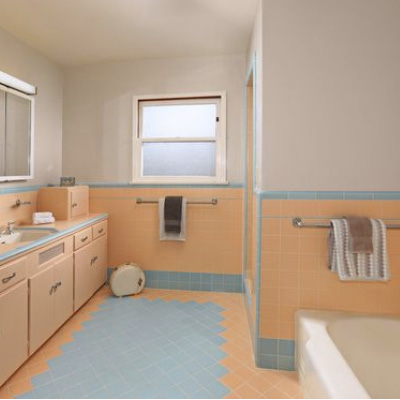
You may decide that the layout of the space is awkward or inadequate to your needs, however. You may decide that there are elements of the original bathroom that are worth preserving that you want to, for example, um, something we suggested to a recent client. They had two complete time capsule bathrooms with relatively generous layouts, one with a pretty charming yellow tile setup, one with a pink and blue accent tile setup that wasn’t quite as beloved. Um, but they were looking at what needs to change in the house.
The kitchen layout was dated and very hostile to their sort of family structure, but did they need to change the bathrooms? Not necessarily. They didn’t feel a pressing need to do that, and I didn’t feel a pressing need to recommend that to them. It did seem that the built-ins were a little worn out and they weren’t equipped with the kind of easily open and closable doors and drawers that are particularly handy for multiple kids going in and out of a space all day long.
So we proposed that they could simply replace the vanity in place in such a manner that would keep all of the original tile. They could potentially keep their existing plumbing fixtures and just set them into a new countertop. The mirror could be replaced, and I didn’t love the way the light fixtures were oriented, but we could set all of that up.
And because we weren’t going to move the major locations of pieces and we weren’t going to replace the tub or the toilet, we didn’t need to touch the tile. That could all stay. Thinking about the why of that space led us made a very conservative choice financially and a very preservative choice for the vintage charm in the house. And even if they change other parts of the house as they go along through this remodel, hanging on to that anchor point of preserving the original tile in that bathroom will help everything else feel a little bit more connected back to what’s going on in the lifeline, the lifetime of the house. Saves money, saves style. And it would be just as easy, I think, uh hiring a contractor without having gone through a design process, they would probably have walked through the house and checklisted, oh, there’s failing cabinets in this bathroom. Maybe this bathroom is due for an update. Let’s do the bathroom. And then rather than a charming but slightly worn 19 mid-50s bathroom in five years from now, they would have an already getting dated mid-2020s bathroom to deal with. The clock starts as soon as you do the work.
Now, on the other hand, sometimes the why questions pertaining to a bathroom lead us to know that we’re probably gonna make some fairly aggressive changes to the layout. The division of sp of sort of bathroom core spaces between two different bathrooms are not allocated properly for the way that the house is going to be used today. I actually have two projects on the boards right now, um, one we’re just wrapping up and one we’re gonna be kicking off soon, that need more of that approach. That we’re gonna be testing, is there something we can do to help these bathrooms function better with their current division of shared bathroom versus owner’s bathroom?
Or ultimately, is the way that the house is about to be used by its next occupants just gonna be so different? And the original division of spaces between two tightly packed bathrooms just awkward enough that it’s not worth preserving. We’re gonna test both things, but the question always comes up, and we will tell I’ll, you know, I’ll also be addressing sort of the kind of questions that come up when I chat with people often about bathrooms in a 30-minute design consult. Is it worth it to change up this bathroom? What will be gained? What will be lost? And in the balance of those two questions, is it worth it to do something as drastic as changing up layout, or should we try to work within the existing footprint, which gives us the opportunity to try to preserve, for example, existing tile?
Um, in the case of a bathroom that has already fallen victim to an aggressive flipper-style remodel, the answer is nearly always that it is worth it to come back and at the very least substitute again some better quality finishes, fixtures, et cetera, for the choices made by someone who was only trying to pay cheaply for materials and sell the house to someone who could only see the value in something shiny or new, or even sadder, perhaps a homeowner who made choices for their own space based on the cheapness of the materials and assumed that it would feel like an improvement in quality simply because it was new.
This is also a place where returning to a why-based philosophy will help us push back on the entire remodeling industry, which, like many other industries functioning under the general umbrella of capitalism, push us to do things quickly, cheaply, and sacrifice on quality. Instead, let’s think about put the slow food movement, the slow fashion movement. Um, I’m not too interested in a technical one-to-one comparison here, but just taking it as a as a metaphor, what does it mean to plan a slow remodel?
Not one that takes a lot longer than you hoped, but one that isn’t about chasing quick fixes or patch jobs or making compromises to get something done now that doesn’t even ultimately serve the purpose that you set out to accomplish. If we’re gonna go to the trouble of making a change to our home, we want to feel like the change we’ve made is worth it. It’s worth our time, it’s worth our money, it’s worth our energy. And if doing it a little bit more slowly, if thinking about it for longer before we do it can make that happen, then yay, we get to push back on the system of constant marketing that is being pushed in our face by social media, by uh the home remodeling industrial complex, etc. Capitalism, basically.
Now, the other piece of that capitalist equation that makes it hard for us as owners of mid-century homes who want to make good choices for them is that our lives aren’t necessarily as settled as we might like them to be. Some people have or choose lives where they know they will stay in one place and make other choices in their life around it. Others find ourselves moving for education, for employment, for family, for opportunity from one place to another across the country or out of the country.
So it’s always easiest to make choices for your home in a long-term sense when the planning window for your life in the house is your life. When I work with a new master plan client who tells me that they’ve bought a house in a neighborhood that they want their kids to grow up in, that they’re planning for age and place details, that this house is near three or four of their family members, they think of this house as their forever home. It is very easy for me and for them to talk about the choices that they are going to make as investments, not in the financial value of the house, but in the life that they’re gonna live there.
That means making choices that fit their personal preferences, uh, choices that should last, chosen with decades in mind, installations done with maximum care, finishes that are meant to endure. In other cases, folks that I work with know that they might not be able to commit to staying in the house for that long. We might be talking about improvements to make for a three-year or a five-year or a ten-year planning window.
They want to make improvements to change it, to fix it up, to repair it anyway, but the planning math does change a little. In some cases, someone who plans to stay may find a reason that they must leave, and someone who assumes they’ll move on may end up staying in a house longer than they intended. When I bought my ranch and started changing it, I actually thought it was not going to be a long-term place for me. I was treating it a little bit more as an architectural project lab, and I definitely wanted to make smart choices for it, to infuse it with
good design, both of a sense of personal and professional pride, if nothing else, and to enjoy the time I spent in it.
But I admit, I do see the house differently now, both ten years into living in it, and knowing that my window of living here might be very long. So this is an important thing to know about your own circumstances and your relationship to your house. You don’t have to ponder it too deeply to know the answer, you can simply answer it. Do you think you are currently living in your forever home? Or do you have some pretty clear reasons to believe that your time in this house is temporary?
Not for nothing, but also I’ve been in my house ten years and I’ve gotten 10 years older in the interim. The way that I think about longevity in my mid-40s isn’t the same way I thought about it in my mid-30s. But here’s the thing: no matter how long or short my lifespan is in this house, how long you plan to live in yours, the house is still going to be there. And the choices you make for it have the potential to last or not. This reminds me of a great conversation I had a couple of years ago with my friend Susan Holla of Make It Mid-Century. I’ll link to one or two of my conversations with her in previous podcasts in the show notes page.
But we had a lovely conversation about how much we love mid-century homes and why it’s important to make good choices for them. And that honestly, there should be an element of altruism in an ideal remodel of a mid century home. There’s what we do for ourselves so we can enjoy our lives more, so we can feel comfortable and safe and convenient in our houses. But there’s also taking care of a mid century house and an act of stewardship. This house has been around for 70 plus years and could very easily last. 70 plus years again, or well beyond that. So, how can we make choices for our homes that will last? Not only through our own tenure, but beyond them.
Now, this is not to say that you might not find yourself remaking some of the choices you made on your home in earlier years. My bathroom is a key example of a room I plan to touch again. I didn’t do much to it when I was first moved in. Um it and it it what didn’t have much to recommend it. It was mostly a replacement of 90s Home Depot light fixtures and uh vanity and etc. I removed the old man toilet with the power flush that’s had like a jet taking off and replaced it with a modern low-flow Toto flooring I liked better.
But as I reflect on those changes now, they weren’t the most long-term thinking I could have done, and they were not really in keeping with the original style DNA of the house at all. Such is the nature of first home improvement projects. Here’s the thing. We’ve come back around to bathrooms specifically now. It is theoretically pretty easy for me to come back and do my bathroom again. Bathrooms are the smallest and most discreet object space in any house to be remodeled.
And companies specialize purely in bathrooms. It’s possible to come in, take out all the fixtures, scrape off all the finishes, put them all back in fresh any day of the week. You can DIY it, um, or you can hire someone by pointing at a few pictures in their lookbook and making the most obvious of choices and update the bathroom to today’s standards and trends without thinking about it too much at all. But this is why I’m happy to talk about the concept of why versus how in a remodel at the kickoff of the bathroom season, because it’s a microcosm for the greater approach we take to remodeling our home.
It is neither cheap nor easy to take on a remodel, no matter how quick and dirty you do the job. It’s going to cost money. It’s going to require breaking inertia, letting strangers into your house to make noise and dust. It will take a certain amount of time no matter how fast it goes. But far too often we prioritize spending a little less time, money, energy to make those quick choices for our house. And then we get to spend the next 10 years thinking, oh man, I wish I hadn’t done it that way.
And I’m really going to have to come back around and do this bathroom again. We make quick choices when we should be thinking long term. So as I crack into the bathroom season and talk through the approach that I take as an architect to layout logistics and material finishes in a mid-century space, let’s frame all of it, not as a quick fix, but looking for a solution that can last as long as the house has already lasted.
For those of us in mid-century homes, that means trying to imagine choices that we could make right now that would be good for another 70 plus years. Now, never say never, but I don’t think most of those choices are going to be found on allmodern.com. So stay tuned for another pithy, relatively focused season where we’re going to talk about bathrooms in the context of regrettable choices made in the past and how to fix them. Tight-space logistical issues, some of the original mid-century design moves that have just not landed as well with today and perhaps need adjusting, and some that are charming and should be preserved at all costs. Some fun history, some remodeling philosophy, because you know I can’t stop myself, some linked sketches and pictures.
I’ve got a great conversation coming at you next week with my friend Aletha of True Home Restorations in Michigan. We’re going to talk about the personal choices that she and I made for our own homes and how she recently took on a remodel of her bathrooms. Again, not scraping them back down to scratch, but adjusting several of her original choices made shortly after she moved into her house while preserving some of the others. The result is really nice, and I hope you find some helpful advice there for anyone who’s listening to this that has made choices in their own home they don’t love anymore.
So to come back around to the question of why questions versus how questions, there are so many things we can do to improve a space that actually make a difference that may or may not even show up in a lookbook of pretty bathroom updates, prioritizing wise investments in long-term maintenance, like a whisper quiet but super effective bath fan to make sure humidity doesn’t take your bathroom out earlier than it needs to be.
I want us to focus on why and on the broader planning horizon of planning a remodel for your house that will last as long again as the house has already stood as a consistent theme for this season, even though the season’s theme is also the littlest, cutest, most sort of tile-finished spot in your house. Um, let’s talk about what it will mean to plan a slow remodel of a bathroom. And that’s it for today. You can find references in the show notes page.
So links to past conversations I’ve had with Aletha of True Home Restorations, of Susan, of Make It Mid Century, and check out the excellent podcast of Tara McMullen, What Works, and some of the things she referenced in her June, ooh, what was it? Her June 3rd episode that got me thinking about all of this. There’s really not that much overlap. I kind of took the idea and ran with it into a different direction. So if you found today’s conversation interesting, you will find her separate podcast fascinating. And I will be back next week with more on making great choices for mid century bathrooms. See you then, mid mod remodeler.
21min readMost mid-century homeowners have L or U-shaped kitchens. So, where did the “open mid-century kitchen” myth come from?
Any Pinterest or web search on “mid-century kitchen” is going to yield a plethora of open plan kitchens featuring a central island. But, as we learned a couple of weeks ago from friend of the pod (and mid-century houses everywhere), Atom Stevens, a mid-century kitchen is a room with four walls. Most of our mid-century homes were built with L or U-shaped kitchen featuring wall-engaged cabinetry for maximum single cook efficiency, NOT a central island. On the high-end we might have a peninsula dividing our kitchen from a “cozy” (ahem…tiny) dining area.
So where did this “open mid-century kitchen” myth come from?
Well, partly from TV sets built for filming mid-century families like the Bradys and the Petries. And a few high concept, architect designed mid-century homes feature brilliant, functional island designs that then influenced high-end home builders throughout the country. But that took some time and these tend to be homes from the later part of the era.
So, who actually started the whole thing?
I’m wrapping up our kitchen season with a deep dive into one of my all-time favorite open kitchen plans – it’s also very likely THE OG island kitchen – The Stahl House (Case Study House 22), designed by California architect Pierre Koenig.
You know this one…even if you think you don’t. It’s been featured in dozens of television shows and films, from Colombo to Playing by Heart. The Stahl House is famous for its high-drama views and distinctive pool. But the kitchen is where the real design work happens. Koenig didn’t just place an island in the middle of a room; he created a space that balances openness with intentional definition.
(June 1960 issue of Arts & Architecture featuring photos of Stahl House/Case Study House 22 by Julius Shulman)
While you shouldn’t (and likely can’t) copy and paste a design from a glass-and-steel cliffside landmark into your own home, this house is a masterclass in how to tailor a space to specific needs. It’s more than just a “cool” kitchen. It’s a kitchen built to fit the lifestyle of its occupants.
Even in an open floor plan, Koenig defined the kitchen as its own distinct space. He used a slightly dropped ceiling—which may have originally featured lighting hidden behind a translucent screen—to create a sense of enclosure without needing four solid walls.
He incorporated a full-height wall that houses the refrigerator and oven. This creates a “protected” zone where clutter can be tucked away, providing a spot for recipes or messages that don’t need to be on display.
The kitchen island allows for movement around both sides. By providing multiple routes of travel, Koenig eliminated potential “traffic jams,” a concept that is just as important in a kitchen as it is in urban planning.
Design Moves You Can Borrow
Us of lesser means or colder climates don’t have to own a $25 million architectural landmark built of steel and glass to borrow from Koenig’s specific, clever design moves.
Here are a few concepts most of us can use:
Float your cabinets. The Stahl House cabinets sit on little legs rather than being mounted to the floor with a kickplate. It makes the kitchen feel light, airy, and “floaty”—a classic mid-century move that works beautifully in modern updates.
Use height to your advantage. Think about where you want to see through a space and where you need screening. In the Stahl House, a higher bar-counter divider and floating shelves separate the kitchen from the dining area. It allows for conversation while effectively hiding dirty dishes from guests.
Embrace constraints. What makes the Stahl House iconic isn’t that it’s “universal” or “in-fashion.” It’s that it was designed specifically for the needs of the people living there and the constraints of a very tricky site. Your remodel should be just as specific to your life.
My birthday is June 8, and every year I offer my age as a percentage discount on my learning programs. The sale runs from June 6th through the 8th, so keep your eyes peeled for the biggest discount of the year! Get Ready to Remodel, my course that teaches you to DIY a great plan for your mid mod remodel at the deepest discount I offer.
Want us to create your mid-century master plan? Apply here to get on my calendar for a Discovery Call!
Need some targeted home advice? Schedule a 30-minute Zoom consult with me. We’ll dig into an issue or do a comprehensive mid century house audit.
Let’s round out the kitchen season with one kitchen in particular. I often get asked by clients if it’s okay to put an island layout into the kitchen of a mid-century house. And my answer is always, yeah, of course it is.
While builder-grade ranches in the Midwest typically had an L or sometimes a U of wall engaged cabinets, there were some original island designs even in the mid-century years. And one of my personal island kitchen icons is the one designed into the Stahl House, or Case Study House 22, by California architect Pierre Koenig.
This house is mid-century modern with an all-caps modern, but I think it also can serve as inspiration for any of us trying to make mid-century appropriate choices for houses today. Hey there. Welcome back to Mid-Mod Remodel. This is the show about updating MCM homes, helping you match a mid-century home to your modern life. I’m your host, architect Della Hansman, Mid-Century Ranch enthusiast. You are listening to episode 2407.
Okay, so a couple of bits of business before I get into talking about what’s cool about this house, what’s individual about this house, and what we can learn as potential modifiers of mid-century kitchens from this particular house. This is going to be the last episode of season 24 of the Mid-Mod Remodel Podcast, and we’re going to take a little break lasting until mid-July.
We’ll be back with another season focusing on bathrooms, another incredibly common area for remodels, and an area that’s important to get very right if you’re thinking about making great choices for your mid-century home. Between now and next season, there’s a couple of key calendar items I want to draw your attention to. The first one is that this weekend, well, really next Monday, is my birthday.
And not to make it all about me, I actually want to make it all about you. Every year on my birthday, I discount the Midmod Remodel courses and learning products. So if you are curious about joining Ready to Remodel and getting round-the-year calendar advice on how to make good choices for your house and getting access to the suite of support materials, guides, references, lessons on mid-century structure, mid-century layouts, mid-century materials, all of that is included in Ready to Remodel.
And we will be discounting that and all of the two-hour design clinics, like the mid-century kitchen cleaner recording, which we just re-upped, by 44%. Watch your email this weekend only for that discount.
And I guess the party that I’m inviting you to is next month’s Architect’s Office Hours as a happy member of Ready to Remodel. And then for every month thereafter, on the first Monday of every month, we get together and I answer all of the pressing questions that my current remodel students have got about their homes, how to talk to contractors, how to choose materials, how the height to hang your pendant lights, tricky layout challenges, all of that and more. So I’d love to have you take advantage of this.
This sale happens only once a year, but it’s been a fun tradition, and we always it’s fun to get an influx of new members joining the Mid Mod Remod Squad for my birthday and yours. Um the other thing to note is if you’re looking for hands-on design advice and assistance from MidMod Midwest, then we will be having our annual summer office closure the week before and after the 4th of July this year. So we won’t be taking new uh work in during that time.
And we our current clients will, hey, if you’re listening, you’ll hear from us that we won’t be communicating with you during that time. We’ll all be refreshing our creativity and our energy and being whole human beings during those two weeks. But I will say, if you’ve been thinking about starting a design process for your home at any point in the near future, then I recommend you get onto our calendar for uh a one-on-one conversation with me sooner rather than later in the month of June.
We’ve been booking out quite far right now. Something about everyone’s mood has got people feeling active, and we are booking out for projects. Design projects for signing now are gonna be finishing up in the fall. So if you have ambitions for changes to your house you want to make this year and you’d like to work with MidMod Midwest to make those changes, now is absolutely the right time to fill in our apply to work with us form on our services page.
You can find links to all the different references I’m gonna make during this episode and how to work with us and information about the birthday sale on the website at midmod-midwest.com slash 2407. Okay, so let’s talk about the Stahl house because it’s been on my mind recently for several reasons, one of which is that it is currently for sale.
Yes, this piece of mid-century history is a private residence, and as is the right of the private residence’s owners, um, now the children, the I would say quite adult children of the original owners, they have decided to no longer be responsible for this and they have put the home on the market. There is it’s such an iconic house. It is a national landmark that wallpaper magazine wrote an article about the fact that it’s been listed for $25 million. If you have $25 million laying around and you would like to make a lifelong commitment to architectural history, maybe check out that article and the listing.
If you don’t have $25 million, check it out either way. This house is, I mean, it’s not a mid-century ranch. It’s not mid-modest or anything along those kinds, but it is, in my opinion, a perfect example of fitting a design to the specific place and the specific needs of a family. As are all of the case study houses, they’re really what’s the plural of Tour de Force? They are really Tours de Force? I don’t know. I don’t speak French very well at all, really.
But they are they are all incredible adventures into what is possible with creativity in design. And although, yes, it was not a cheap house at the time, it was a reasonably priced house at the time. Now, of course, it’s $25 million, but it doesn’t, it’s not laden in luxury, it’s not enormous, it does have a truly incredible view looking out over a precipice at the city of LA below it. But this house really to me represents what’s possible when we take constraints and make them interesting. It has a couple of specifically fascinating features.
The bedrooms front right onto the pool. There is basically no front of the house. You pull into a little carport, walk through a little gated opening, and find yourself walking along the bedrooms, which look out of the pool, you get to the bedrooms from the pool deck, and then looking at the L-shaped part of the house that projects out over the cliff edge, which is kitchen first, dining area next, and then the projecting living room with an open, floating hearth. It’s a steel and glass structure. It’s really remarkable.
I, if you can’t conjure images of this when you hear the name Stahl house, go check out some links on the website to images of it. But today I want to talk about the kitchen specifically because it’s a really interesting space. I want to talk about it in plan, the way it works from a circulation perspective. I want to talk about it in elevation, the way that different heights of different parts of the kitchen relate to each other, and I want to talk about it in perspective, the way that the house relates, the way you see it from the pool deck, the way you see it from the living room, the way you see the kitchen from the dining room.
You will not remodel your regular house to look like the Stahl house. You’ve got to start from scratch to make it that. And you will not remodel your kitchen to look exactly like this kitchen. But there are design moves we can take from this house. And when Koenig was designing this, he used an island layout in a relatively open space plan in a similar way multiple times. He doesn’t put out island completely on display the way that a modern sort of blow it all out open plan remodel would do. He does create some privacy.
In fact, um, as I’ll get to a little bit later, he designed the kitchen of this house with sliding panels that could block it off somewhat from view. Although I would really love to know if they were ever actually used regularly by the occupants of the house. But he designs a central island that you work around and then a secondary island, which serves as kind of a buffet or a bar counter that screens the space visually from the more social parts of the house.
When you look at the house in plan, I’ll put I’ll sketch up a rough plan and put it on the show notes page. You will you will think that the kitchen is entirely the open center of the house. And that’s not untrue, but it is also very visually self-contained. It has a specific material language that happens only in and around the kitchen.
The ceiling is actually dropped slightly over the kitchen area. It has its own lighting solution that it may be fluorescent lights behind an opaque or a translucent screen, which, if so, I hope they’ve fixed that with LEDs by now. But it has a drop ceiling. It is surrounded and defined in a very particular way. His go-to combination um for kitchens, and I if you if you read books about him, if you scroll through examples of him, I’ll link to his reference page on usmodernist.org.
You can see a number of his houses have riffs on this kitchen design. I actually don’t know whether this was his first or his last, his greatest, his pinnacle. I’m not sure, but this kitchen is excellent, usable, social, and I’m sure has always been really the heart of the home. One thing he does that I adore is that he has part of its open plan and part of it has a full height wall where he has an embedded refrigerator spot.
So you can slide it in and it feels not chunky, not sort of standing out blocking space. He’s got a wall oven and probably an added after the market, aftermarket uh wall microwave in a full height storage area. And on that same bit of wall, there is a bit of wall-facing countertop with side enclosures. On one side it’s the whole wall fridge, and on the other side it’s the built-in wall space.
This is really helpful to have in a kitchen, even in a relatively wide open kitchen, to have a little bit of counter that’s more protected, a place to tuck something somewhat out of complete view, clutter is a little less visible in that spot, and you’ve got a bit of kitchen wall surface for plugging things into or posting up messages or recipes on or putting some common phone numbers on, regardless of how open plan the rest of the structure is.
The indisputable center of this kitchen concept that you see perfectly exemplified in the Stahlhouse is a generous four-foot island that I think is 10 or maybe 12 feet long. I have to check my notes on that. But it has room for full-depth undercounter cabinets accessible from both sides. He places the main kitchen sink here. There are drawers for common reach and tools. There’s a space with no storage underneath that you can pull up a chair and sit in the main working side.
And then the cooktop, not the it’s not a range, it’s a wall oven and a cooktop, is also located in that island. There’s a fairly clearly defined working side of this big island and then prep or assistance side. The work side is has this sort of kitchen triangle appliances in it. It’s got access to the refrigerator, to the oven, to the cooktop, and to the main sink.
On the opposite side, there’s a secondary sink in the little bar stool, rather, in the little um bar height counter. And that’s a space where someone could sit and look at the cook, or could chop and prep with the cook, or could do a more elaborate baking project, or spread out homework, whatever you want. They’re in the kitchen area, but you’re not in the kitchen working zone. I did note that it is an electric cooktop in the island, nicely spaced out from the main sink.
So the nice thing about having a full island that you can circulate all the way around is that you’ve got multiple types of work that can happen multiple types of places. In fact, you’ve got the secondary island, the narrow one that separates her from the dining room, could be handy for bar top duties facing the dining area, among other things.
And it is backed with a breakfast bar style higher divider that screens it visually from the dining area. This is really important to the perspective viewing of this kitchen. The fact that there are four posts, four columns inside the house, non-structural, that define the edge of the, or four column points. There’s sort of lighter mini columns that define the island that separates it from the dining room. But there are vertical elements that surround all four corners of the kitchen within the house unit.
There are circulation aisles on both sides, and that that higher island that separates it from the dining room has both a bar height counter that gives you just a little bit of visual privacy and some floating upper shelves that again, you can see through them, you can talk through them, you can pass through them, but they create a sense of separation between the dining area and the kitchen. They also very practically block your view.
Specifically, if you are sitting at the dining area at the dining table, you are no longer able to get eyes on a pile of dirty dishes in the kitchen sink or any remaining detritus from the meal prep. It’s all screened from your view, screened from your guest’s view as well.
This is a really lovely thing. And I think when we are thinking about how to interpolate or borrow ideas from this kitchen, having a relatively open connection between a kitchen and another space is fine, if that’s your preference. In my episode a few ago, my interview with Adam, uh, where we talked about the definition of a mid-century kitchen, we defined it as a room with four walls. This is definitely not a room with four walls, but it is still defined as a space. It’s a space with four sides.
And the biggest distinction, actually, there are two the strongest wall side is a real wall that separates the kitchen from the corridor that leads to the bathroom and owner’s bedroom and private spaces in the house. And the next strongest, we’ll call it a quote wall, unquote, is that separation between the kitchen and the dining room. And then on the on the two sides that face out to uh the neighbor’s yard beyond and out to the pool deck on the inner L, there’s not much of a sense of wall, but there is an overhead connection.
If you were in the space in three dimensions, you would feel it as a defined space. So this is what’s so interesting to me. If we think about the Stahlhouse, the iconic image, the um Julia Schulman photograph that is probably most commonly shown of the Stahlhouse is not the kitchen. It’s a shot taken at night of two women in circle skirts sitting in mid-century minimalist furniture in a glass and steel box suspended out over the night skyline of LA. High drama sticks in your mind. It’s gorgeous.
Um honestly, I’ve I have not been to the Stahlhouse. I would love to. I hope that the new owners permit tours because it it’s on my bucket list and I’m not made it there yet. Uh, I am not great with heights, and I wonder how I’ll feel if I get a chance to stand in that living room. Personally, I’ll probably spend more time standing in the kitchen for two reasons. One, because I like it better, and two, because I don’t like feeling like I’m standing over a cliff edge.
But this house is so much more interesting to me than that high drama image because the kitchen is so specifically functional. Thinking about it in perspective, it does so much. Thinking about just a straight cut section through it, the different full height and partial height areas where you can reach across, where you can walk across, where you can see across, is so well thought out, so specific.
Um, it really makes me wonder about the the personal life, the history, the interests of the architect, Pierre Koenig. Did he cook? Did he spend time in a kitchen? What was his level of sympathy for the women in his life who are more likely to have been expected to spend time in kitchens at that point? He really uh put empathy into this space. What was his uh conversation style with the original owner of the home? What did she request and how literally was that request carried out?
I’ve mentioned several times that the house you don’t understand in plan how it feels connected and how it feels specific, but it is actually a fascinating space to discuss in plan. When we talk about circulation, sorry, architect word, when we talk about how you move around this space, there are generous, if not enormous, aisles of movement surrounding the kitchen and within the kitchen.
Part of the reason that an island of any size is really useful in a kitchen, part of the reason that I recommend putting a 22 inch by 22 inch piece of furniture butcher block into the center of a classic mid-century U-shaped kitchen, even if it’s only seven feet across from one cabinet face to the other, is that humans are so capable of getting into traffic jams unless there is a defined route of traffic.
Okay. We’re gonna take a pause on talking about iconic California high modernism, and we’re gonna talk about urban planning and the use of snow to map routes of travel in Midwestern cities. This is gonna be relevant, I promise. I care a lot about urban planning as well, even though I don’t talk about it very much here, because my sister, who is a family medicine doctor with a deep professional interest in pedestrian safety in walkable and multimodal cities as a health indicator, has done a lot of research, uh, particularly in her MPH, on pedestrian safety, on bike safety, on urban planning infrastructure.
And here’s something that becomes very clear when you start to study this, which is that human behavior is more modified by physical structure than it is by a suggestion. You can paint stripes on the street, and at the end of the day, cars will, people in cars will ignore them most of the time. But any amount of actual built infrastructure makes a night and day difference. That’s why poured cement bump outs at a pedestrian crosswalk do cause drivers to slow down.
And you can actually, when I mention the word snack down, if you have not heard this, this is a weird little fun thing to Google. This is when you look for patterns in snowy winter landscapes, in urban landscapes, um, to see where the drive patterns are and where the walking patterns are, and you can see the worn away parts in the snow to see how people are or are not using parts of the street.
And then you can go in and sort of mark out, oh, you know what, no one’s actually even driving here, and also they shouldn’t be. So why are we making this pavement? This should be uh a concrete bumper with a little bit of a urban garden in it, and that’ll make it safer for someone to walk less of a distance across car area from one sidewalk to the next.
If you did not know the term snack down, you’ve just learned something new, and I bet you did not expect to get it in an article in a podcast on the Stahlhouse and Pierre Koenig and Julia Schulman. Uh but the other thing that’s really true is that so like a zebra stripe paint job on the job on the ground doesn’t do the same job as a pedestrian bump out.
Similarly, painting a solid white line to define a bike lane in a wide road does not protect that bike lane. Um, in the Wisconsin winter, it becomes absolutely invisible to the eye as soon as we get a solid slick of snow on the roads. And even in the middle of summer, when it’s completely visible, people will park in that bike lane if they personally feel a need.
But even the slightest little row of built-in bollards, vertically plastic, vertically mounted plastic dividers spaced out every six or twelve feet, and a tiny little concrete bumper that any person killer modern SUV could easily roll right over, does very effectively prevent people from parking in the bike lane and keep the bike lane safe. It’s a huge difference in protection for bikers. And even though the step up from conceptual to actual is really small, it makes them feel nearly as safe as a chunky concrete wall, but with better visibility.
So, what does this mean for the Stahl house? Having, as we have in this floor plan, two distinct full loops of circulation. So you could get around the kitchen by going around the island, little loop, or you could get around the kitchen by making a full loop out through the bedroom hallway, around through the dining room. You could go outside the house. I don’t know that you can get outside the house on the neighbor side.
So maybe it’s two overlapping loops. But there’s such a good way to get around. You can always move around the other way. And having multiple routes, you can go around one side, you can go around the other side of the island, allows for slimmer spacing inside the kitchen itself, more space devoted to the counter surfaces, and then you can run around someone rather than hip bumping with them to get to something on the other side.
Sure, it’s a few more steps, but it makes it possible. I find it to be really interesting that you can actually approach the kitchen from two sides. You can walk along the outer edge of the house and you can walk along the inner pool-oriented edge of the house, and that they chose to make it a full island rather than a wall-engaged peninsula on one side. I really would love to know use case, you know, how much people did come up one side versus the other, slickerware patterns in the flooring material or something like that.
But it is also a very creative, pleasing balance of the space and deals very nicely with the the walls of the house being essentially huge sheets of glass and big sliding glass doors. So here’s the thing about this house the choices. Made for this kitchen would not work everywhere. This house has a lot of features that we can be inspired by and we can generalize from. Have a look. I’m going to be doing some sketching after I wrap up this episode and I’ll put the sketches in the show notes.
On the way that I think this house works so beautifully, some of the features that can be adapted or borrowed. I love the way that the cabinets float. They’re all sitting on little legs. It’s a very European style design rather than being mounted with a kick plate right to the floor. I’m sure it’s hard to dust under the center of that giant island, but at the same time, the whole thing feels very light and floaty and again rests nicely inside the house. That’s a choice that you could borrow. The material palette is a choice you could borrow. The suspended ceiling is an interesting choice to borrow.
But you’re not going to copy and paste this. You’re not going to um translate this one-to-one from that house to yours. And when you look up the Stahl House online, you’ll see a lot of people criticizing it, talking about how weird the bedroom designs are or how they don’t like this kitchen. It feels too open. One of the reasons I love it so much is how odd some of the choices are, how specifically they were made for the site and for the family that lived there.
It blends very much with my personality and my approach to remodel design, which is very informed by the needs of people who will use it and the existing conditions of the house itself. I can’t, I won’t take on hypothetical design projects. People have asked me in the past if I would do a design project speculatively for a house they’re planning to sell.
And my answer is always absolutely not. I don’t know what features, what sociability, what conveniences would be prioritized by the next owners. I can’t design something that will work for someone I’ve not met. And I don’t want something to be built into the house that will then rub the future owners the wrong way and be torn out and thrown away in the next five years. Similarly, people sometimes ask if I could design them a new mid-century style home, a new build. And I could know everything about them, but personally I don’t enjoy starting from scratch. I like constraints. I like complications.
So what makes this house so great is how specific it is to the constraints of its very weird site, and it’s apparently quite creative, unusual family. It is the freedom that you can find in constraints that Pierre Candid work with that make this house iconic today. It’s not that it’s bland and unobjectionable and inoffensive in this sort of HGTV Zillow makeover flipper way, because it is not.
And it’s not because it’s universal and easy fit for every space and every family, because it isn’t. It could not be dropped into any neighborhood in America. This design would not work in a place where your neighbors were too close. This design also required the work of a structural engineer to set it up with steel beams and concrete pillars that support it over the cliff. Architect Pierre Koenig worked in detail with a structural engineer on this, in this case, William Poruch.
He partnered with structural engineers throughout his career to set up the complicated steel and glass designs that he put up, that he put together. So we still see the Julius Schulman photo shoot images of this house today. We still know the name Stahl House. Um, we still think about this kitchen today because of how uniquely and specifically fit it is to its original design brief. And that I think is maybe the most important takeaway. But also this really cool open plan glassed in island design kitchen is really, really cool. Is really, really, really, really cool.
So um I’m gonna link out to some places where you can check out that amazing Julia Shulman photo shoot. I don’t know that, I mean, you can also see snaps that tourists have taken in more recent years, see them in modern color, but uh no one’s really documented it better than he did. And I’ll have some fun little sketching around that I will do in my free time between now and the time of airing for this episode.
But what I really want you to think as we wrap up the kitchen season is how can you end up with a kitchen that feels like the centerpiece of your home? It doesn’t necessarily need to be filled with the most beautiful, expensive, high-end materials, but the specificity of the choices you make, the care that you take with them, the amount that you honor what was originally in your house, or choose to modify it because it was never really doing the most important bold thing.
Let’s get inspired by a crazy cool building like the Stahl House. And by the way, if you want to see it show up in modern lights, this house is so cool and so interesting that has been featured in multiple movies. The first one just a few years after it was built, um, Smog from 1962. Uh things I recognize are Karina Karina, Playing by Heart, Galaxy Quest. It was in an episode of Columbo. Um, I’ll put a link to all of those things from the Wikipedia page also into the show notes page. But that’s gonna be it for today.
Go check out all of that at midmod-midwest.com slash 2407. And don’t forget to look out for the birthday sale. This is your big opportunity to jump into Ready to Remodel at a huge discount. Won’t come around again until next year, when it will be, of course, 1% a better discount, but still, don’t wait.
And if you’ve been thinking about getting in touch, wanting to work with Mid Mod Midwest on a master plan for your house, reach out now before we shut down for the summer and before we get any more booked out. I’ll be back on July 16th with another season of the Mid Mod Rodel podcast. And until then, have a great early summer.
15min readI tell my clients that there isn’t one “right” answer. I tell my students that there isn’t one “right answer. But honestly? I have opinions.
Do you ever find yourself wishing that someone would just tell you the right choice for every finish in your remodel? Between the tile, the fixtures, and the endless cabinet options, the sheer volume of decisions is EXHAUSTING.
Now you probably know me as the person who ALWAYS has options for you to consider. I like to offer alternatives, pros and cons, and let people tell ME what possibilites are landing best for them.
Options for the optimal layout. Options for tile color. Options for replacing or keeping your original windows. There’s a silver lining for every cloud and an advantage for every starting situation as I approach a remodel.
I tell my clients and students that there isn’t one “right” answer all.the.time.
Straight talk, tho?
I do have opinions. Lots of them.
My friends and family know me as someone who will judge a poorly designed building harshly AND at length.
Let’s focus on the positive here, though.
Just for today, I’m putting aside the “it depends” caveats and giving you my unvarnished hot takes on THE CORRECT choices for a mid-century kitchen update.
40min readDoes a love of time capsule homes always extend to an original kitchen? Realtor Atom Stevens might know as a time capsule lover and someone who’s clients share that love.
Does your garbage disposal give you a thrill?
Maybe you take it for granted. But you know who DID NOT?
The folks writing ad copy to sell our grandparents their new build mid-century homes, that’s who.
They were kind of obsessed. SO MANY new home ads from the early mid-century make a point to feature that this home comes with it’s very own garbage disposal.
That’s just one weird, wonderful detail that came up in my conversation with Atom Stevens, today. Atom is a real estate agent who specializes in mid-century and modern homes in the Denver area.