
Designing accessibility into your mid-century home during a remodel is easier than you might think.
Mid-century houses have enormous potential to fit every stage of life.
They make great first homes for young couples and singles, were built for and are adaptable to the needs of growing families, and serve owners who choose to age in place.
They also work well for people with living disabilities … especially with a few essential updates.
Let’s talk about how to design accessibility into your mid-century home to fit your life and the lives of the people you love.
Note: this was originally posted 2020. It has been updated and includes a NEW podcast episode, plus the original episode (right down here)!!
TABLE OF CONTENTS
The Big Picture of an Accessible Remodel
Sometimes you need to change the layout of your home in order to make it more accessible to people with mobility challenges. If so these changes can be DIYed or might require a full contractor overhaul. In general make sure someone can:
Get into the house
This might mean adding a ramp or lift to the house entrance to span the distance between grade (the ground level outside) and floor level inside. Make sure that the pathway into the house is smooth with minimal thresholds or other impediments to a smooth step or roll.
Get around the house
Make sure the hallways and doorways are wide enough for easy access. When in doubt choose simple straightforward pathways thorough the major house areas (and avoid sunken living rooms!)
Pay attention to flooring surfaces. Keep transitions (between one type of floor to another) to a minimum and make sure they don’t create any raised thresholds. Avoid carpets.
Easy access in the kitchen and bathroom
Fit out bathrooms and kitchens with roll up counter spaces, lowered sinks, wide turning radii near the important appliances and minimal thresholds to get into pantries or showers.
Choose accessibility friendly surfaces and shapes
Planning for accessibility can sometimes be as simple as choosing one finish over another or one product over another. There doesn’t need to be a price difference or much of a difference in appearance.
Consider non-slip flooring materials, adding visual contrast for easy navigation, and grab friendly fixtures like lever door handles and single handle sinks.
Little things make or break Accessibility
Make sure all your hardware choices are accessibility friendly. Choose lever style handles, trip free flooring surfaces and good lighting for visibility.
Place sturdy grab bars near tricky corners, key doorways, along halls and stairways and especially in bathrooms. Even if you don’t need grab bars now, add blocking in the walls for likely future placement so that installing them is as easy as possible when you do want them at hand!
Planning an Accessible Remodel is Smart
Wether you have a pressing need for an accessible home right now due to your own situation or that of close friends or family OR not its never a bad idea to plan an accessible update.
Anyone can slip on the ice in the driveway and find themselves laid up unexpectedly. When you do, you’ll thank yourself for choosing a walk in shower with a bench. And when you plan it well it doesn’t need to cost you more stand out style-wise. Again, this is where the clean practical aesthetic of MidCentury design goes hand in hand with a livable house for all ages.
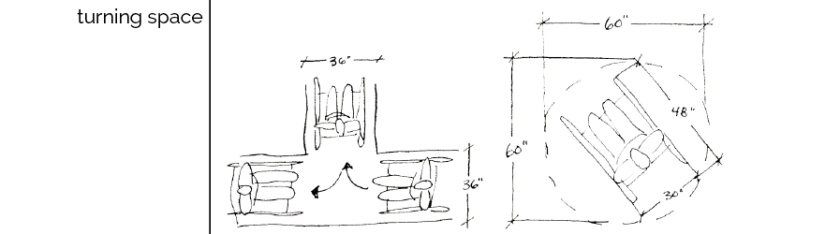
Handy diagrams for Accessible Floor plans


In the (2020) episode you’ll hear …
- A quick over view of the Americans with Disabilities Act or ADA [2:35]
- Some history of how Americans have planned for people with disabilities in the past (spoiler: it wasn’t great) [3:30]
- A guess as to why MCM homes are so much more accessible than earlier eras’ homes [6:40]
- How to bring added accessibility into your remodel plans [8:30]
Listen now on
Apple | Google | Spotify | Stitcher
Resources to Add Accessibility Mentioned in this Episode
- A history of Accessibility Rights and the ADA from the excellent Throughline Podcast by NPR with hosts Ramtin Arablouei and Rund Abdelfatah
- A quick overview of the ADA by the government
- A helpful article on Redfin outlining Home Modifications for Persons with Disabilities by Lexi Klinkenberg
- Join us on in the Facebook Community for Mid Mod Remodel
- Find me on Instagram:@midmodmidwest
- Find the podcast on Instagram: @midmodremodelpodcast
Listen Now On
Remodeling Resources
- Get Ready to Remodel, my course that teaches you to DIY a great plan for your mid mod remodel!
- Want us to create your mid-century master plan? Apply here to get on my calendar for a Discovery Call!
- Need some targeted home advice? Schedule a 30-minute Zoom consult with me. We’ll dig into an issue or do a comprehensive mid century house audit.
And you can always…
- Join us in the Facebook Community for Mid Mod Remodel
- Find me on Instagram:@midmodmidwest
- Find the podcast on Instagram: @midmodremodelpodcast
Read the Full Episode Transcript
00:00
Is the mid-century house you live in your forever home? MCM homes have enormous potential to be the perfect fit for a young individual, a couple, a family growing up, a flexible haven for empty nesters and a solid space to grow old, even as your ability and desire to take care of daily necessities may shrink. These are lifelong houses.
00:18
That said there are a few limiting features common to mid-century homes that can make them not quite accessible, and anyone with a mobility impairment, temporary or permanent, will tell you that it only takes one broken link in the chain to prevent you from independently accessing a space.
00:32
So today, let’s talk about how to make your mid-century home as accessible as it needs to be now and later to fit your life and the lives of the people you love.
00:41
Hey there. Welcome back to mid modern model. This is the show about updating your MCM home, helping you imagine mid-century home to your modern life. I’m your host, Della Hansmann, architect and mid-century ranch enthusiast. You’re listening to Episode 2206.
00:56
Before I get into that topic. And speaking of future proofing your life and planning for the future design takes time, and our design process takes at its core, our Master Plan process between our initial kickoff design meeting with our clients and our workshop meeting where we show them all the options in our solutions package, takes between four and six weeks, but before that, there’s getting all the information, the dream, the Discover, the distill sections, the pre design info together before the kickoff meeting.
01:27
And then, once we’ve shared options with our clients, you’ll want to take a little time to think about them before coming back to us to select your favorite pieces of different schemes so that we can put them together to final schematic documents for you, all of that process takes time.
01:41
And looking at our calendar for the year and how we are booked out already, I would say we probably only have two more slots that are going to be completely wrapped up with design solutions in hand, not just options, by the end of 2025 so for anyone who’s thinking of planning ahead towards getting some remodeling work done next year, right now is the time to get onto our design roster and get your mid-century master plan started.
02:06
You can reach out and schedule a time to talk about your master plan prospects with me anytime you need to. There’s no commitment implied in just having that first conversation about what is possible for your house, what our process looks like, and what kind of design assistance would suit you best. So like I say, let’s plan ahead together.
02:27
And if you’re thinking about getting design work done anytime early next year, now is the right moment to reach out and get the ball rolling with mid mop Midwest, if you are looking for resources on how to further today’s topic how to add more accessibility to your mid-century home. That’s certainly something that we can help you with, internally with our design process. It’s also something that we teach about, that I have content about, somewhat inside of our ready to remodel program, and certainly something that we talk about in our architect Office Hours call It’s a topic I can focus in with you.
03:00
But you know, I was just realizing, I wish I could point you towards a handy workshop that I’ve given on this subject, and I don’t really have one, so I don’t have a plan to put together a new mid-century design workshop in the near future. I’m pretty busy and booked out, as previously mentioned, but this is an important topic. We have done design workshops on spaces around the house, owner suites. Well, that actually does have a little bit of information about how to plan for accessibility in your bathroom upgrades. On kitchens, somewhat Ditto. On…we haven’t done one on basements either.
03:32
Man, there are a couple missing topics out there. We’ve done outdoor rooms, porches, patios, decks, curb appeal updates and how to plan for an addition for a mid-century home. Each of those special topic workshops is available that you can watch in two hours, or space out and put as much design time into the Q and A sections, where I pause and ask people to do their own thinking and design process along the way, take as long as you need with them. Those all exist. But if you are curious about maybe an accessibility, a planning for accessibility Design Workshop. I’d love to hear about it. Or if there’s another topic design workshop that you’re curious about, I’d love to hear about that too.
04:09
Anyway, I didn’t really have that on my agenda for today, but I just thought I would spontaneously mention that I’m always curious about what mid-century house related topics are still a big question mark for you. Sometimes they require a podcast episode. I was realizing recently that we don’t have one on how to choose the right siding for a mid-century house. By the way, the first best answer is, if you’ve got your original siding, let’s work to maintain it. But if you don’t, or you have to change it for some reason, or you’re siding around a new addition space, we’ll talk about the pros and cons of that in an upcoming episode later this fall.
04:43
So I do add topics to the roster because people ask about them, and I sometimes put together design workshops for the weekend because people have asked for it. So if you’ve got a topic on your mind you’d like to hear about, write an email, contact me on. Instagram, leave a comment on our Spotify or Apple podcast platforms. We check all of those intermittently. You know, as we have time or under design work, so reach out and let us know what you would like to know about most, and what you’d like some design assistance or design teaching on the topic of, great.
05:20
All right, let’s get into the topic of accessibility in mid-century homes what they already can do for you and what they might need a little more work in order to do better. I’ve talked about the strong Venn diagram overlap between easily accessible homes, homes that are easy for people with mobility limitations to live in, and mid-century homes at large many times before.
05:44
And if you’re looking for the bullet point version of this, I have a handy short episode on the subject, dating from way back in 2020 jump to Episode 405, if you’re looking for something bite sized. But this topic is endlessly important, always relevant, something that comes up in most of the master plans I create for my clients, whether they have someone in their home or their life right now who has need for accommodations in building environments, or they just want to plan for the future.
06:12
And frankly, we don’t need to plan for that far in the future to find it wise to make accessibility, friendly choices for our houses, anyone can slip on a banana peel and end up in a walking cast or a wheelchair for a limited amount of time in their unpredictable future. So to take the baseline, single level living, open floor plan, simple layouts of a mid-century house, and then plan to improve upon that flexibility, that openness, that ease of access in any the way that we can is just good sense. So let me just quickly refer if you’re not going to jump back and listen to another podcast from another time and another style of mine, what I cover in Episode 405, has a little bit for the history nerds out there that I’m not going to get into as much today about the history of accessibility rights and the ADA the Americans with Disabilities Act.
07:07
For better reference on that than I can give you. I highly recommend the episode of another podcast throughline by NPR that I cited back then. This is a really good reference for a bit of American history that should use attention, and also, just, you know, to understand why the built environment around us is the way it is.
07:29
People can do whatever they want in their houses, but it’s still a handy guideline for things like turning radii and handy heights for wheelchairs, grab bar, locations for bathrooms, things like that. So it becomes relevant as you choose, to pay attention to it, and not to go too far off topic right at the beginning, but as someone who is relatively hail hearty and able bodied living in a house that was last occupied by an elderly person who put in a lot of aftermarket accommodations for their own accessibility.
07:29
I spent a lot of time thinking about accessibility in public buildings in my former job, when I worked in Chicago for a firm that both remodeled residences and also, by preference of my former boss did a lot of designs and conversions of restaurants. He was a big foodie and loved to do restaurant to be in restaurant spaces. So he also worked with restaurant tours. And one of the things we were constantly wrangling with in Chicago was how to safely and legally and comfortably get people up from street sidewalk level, usually just one step, even into a building environment to get into a restaurant space, while preserving an airlock so that cold air wouldn’t fly in, while making it such that the ramp that might be necessary for someone in a chair wouldn’t be a huge slowdown or create chaos in a line and a busy period for people who had different mobility statuses. So that was something I spent so much time working on in residential architecture, we don’t pay too much attention to the regulations involved in the ADA.
08:55
There are things that I did not find relevant and frankly disliked, like the chair lift in the toilet on an old toilet with a power flush that sounded like a jet taking off. That was one of the first changes I made in the house. Was to replace that toilet, but I did not take out the grab bar in the shower, which was obviously installed after the fact. It’s not esthetically beautiful. It’s not particularly integrated into design.
09:29
If I was designing from scratch, I would do it differently. But I have found that with soap in my eyes, when I turn facing forward to facing backwards in the shower, I put my hand on that grab bar and I feel stable. It’s nice. So you know, there are just some things that don’t hurt you to put in or plan for right now, regardless of your need for disability accommodations.
09:52
Also in that 2020 episode, I talk about the different categories of accessibility to think about adding to your house. House in a remodel, specifically, when you’re making big changes to the house, what should you categorically consider, from an accessibility, friendly point of view, and that has to do with a way to get into your house. Are you entering if you’re in California, perhaps you might be in the same exact level outside the house and in in the Midwest, it’s traditional because of the way that our basements are designed, and the way we think about snow and water shedding, to have the main floor of a house, even a mid-century house anywhere between six and 18 inches above grade level or ground level outside that when we take the idea of a ramp slope, ideally being no more than one inch of rise over 20 inches of run or horizontal distance might mean quite a bit of work to get up into the house. But you don’t necessarily need a ramp to be accessibility friendly.
10:49
If you don’t have a person who you regularly use as a wheelchair coming in and out of your house, you might just want to think about, Is there good lighting? Are stairs even and easily visible. Is there a railing, or a thing that you could use as a handrail near any steps that you get into the house? So the range of how do you get from outside the house to inside the house, your front door, your door out to the back, to the back deck, the door that goes in from the garage. All of these places are places where you might think about adding a little bit of accessibility aids. You can also think about replacing or choosing specific fixtures or setting fixtures at a specific height to accommodate someone who is a different height, who is seated as they use them, or just someone who might need a little bit more bracing or stability around certain fixtures.
11:37
So particular product choices or placement can be something you want to contemplate. And then finally, you’ll think about material or finish choices that are less big than you know. Do you have a range? Do you have a roll up sink, but just lever handles on the doors, smooth floor transitions, rocker rather than flip switch, light switches, light switches, that light up so you can see where they are in the dark. A roll in shower, some of these things, like a zero access roll in shower, are features that I would design into any house, regardless of accessibility needs, purely from an esthetic point of view and from a cleaning point of view, less little ledges and trip hazards and things you can stub your toe on a bathroom, and less corners that can accumulate grime in a bathroom. That’s just a win, win win all day long.
12:29
But as I listened back to the episode, I found that I had covered a lot of the basics of what I still believe and practice regularly for my clients, around adding accessibility features to mid-century remodels. One more thing to mention that I didn’t in that episode, I think, is the question of universal design. This is a Google search term you could use if you’re looking to learn more about this universal design. Well, I’ll just use their own definition. Universal design is the design and composition of an environment so that it can be accessed, understood and used to the greatest extent possible by all people, regardless of their age, size, ability or disability.
13:04
An environment or any building product or service in that environment should be designed to meet the needs of all people who wish to use it, not as a special requirement for the benefit of a minority of the population, a fundamental condition of good design. So kind of put another way, this isn’t necessarily planning for a person with a disability to use a space.
13:24
It’s just planning for as many people, or really every person, to be able to use a space based on the design. This is actually a topic that my wonderful operations manager and the producer, effectively, of this podcast brought up to me as we were chatting about it. She is a person who is much shorter than me. I’m a six foot tall woman. I don’t tend to think about reach distances or counter heights, actually, only as far as I think that sometimes they’re inappropriately low for me. I sometimes don’t like kneading bread on a counter that’s below a certain height.
13:56
But she pointed out that for a person who’s shorter, it can be really inconvenient to reach too high, to feel like there are a lot of spaces in a kitchen, for example, that are not appropriately sized for people of her height. This is where I think in a house, I am more likely to advocate for specificity in design that universally serves everyone that is in the house. If you are a family who are all a little shorter than average, I might encourage you to go ahead and set up some of your counter services a little lower than average, to customize your cabinets, to set up a space that’s going to work really well for you.
14:36
Certainly I would not encourage you to put a lot of your most necessary storage up in upper cabinets, up high on the wall. I wouldn’t encourage that anyway, I think that’s an artifact of poor mid-century design. Then again, for a household of basketball players, I might suggest that they consider customizing their counter heights a little higher. This the principles that. Make universal design, to me, really important are in the public sphere, in schools, in restaurants, in public spaces, in government buildings. I think it’s important to create not just accessibility friendly design, but universal design that everyone can use.
15:14
Whereas in your house, I think it’s a little more important to ask yourself personal questions and make sure that you’re setting up the house not for a future, hypothetical user, but for yourself. I think this gets into the context of you who in your house needs any kind of accommodation, who needs any kind of accessibility. Is it someone who lives in the house full time? Is it a guest? Is it the potential of your future self? Perhaps my All right, to put it back into the context of the previous episode, which is a sort of short checklist how to things to consider, I would say the most important takeaway from the episode is how relatively easy it is to modify a mid-century house that’s baseline pretty good for improved accessibility and that you don’t need to make choices that are going to stand out with a neon sign.
16:04
You don’t need to highlight the fact that you’ve made an accessibility friendly choice. In fact, it’s possible that certain elements of a quick and dirty retrofit might be very, very obvious to a guest or future homeowner, but if you’ve planned for them in advance, they might be almost entirely invisible, and that also dovetails really nicely with the concept of universal design just being good design. But what I want to talk to you about today is to sort of put the Master Plan spin on this.
16:35
How do we take the concept of adding accessibility to a mid-century house and think about it, from the 5d approach, dream, discover, distill draft and develop some of the D’s are more important in this case, but I think I can actually make an accessibility friendly option or consideration in each one of those phases. Again, a mini Master Plan approach targeted towards accessibility is going to consider, let’s just go through it. When we’re talking about dreaming, this is the place where we get specific, because you’re not going to just go down a checklist on the internet of things that are useful for people with disabilities.
17:12
You’re going to think about what accommodations are necessary for the person or people you are considering in your own life right now, asking yourselves questions about what you and your family need now and what you predict you might need in the future. There’s not a one size fits all remodel for a mid-century home, and there is not a one size fits all accessibility update for a mid-century home either.
17:33
Now the person you’re planning for may move around the house exclusively in a wheelchair. They may have days when they require more assistive devices, or other times when they do not their mobility limitation might have to do more with grip strength or a lack of balance, and how that affects the way they move from one place to another. This sounds so obvious, but I am forever surprised by how much people are looking for generalized advice, or, quote, unquote, what they should do in a situation, rather than specific situations tailored to themselves?
18:04
So for you, I want you to get really specific. I answer these questions again and again. For my clients, and I have a well of solutions, I will also hit the internet and Google for specific recommendations that help a particular type of need, or are, you know, clever solutions for a particular type of accommodation. But I always want to begin from the experience of my clients. What are they looking for tailored to their own lives?
18:34
So when I get a new client, even a young couple who comes to me for a master plan, if they see the house as their forever home. If you feel like you are in your forever home and you’re planning to make the changes to it that will suit it to fit your life right now, perhaps you’re still planning to have kids. Perhaps you have kids already. Perhaps you’ve got teenagers who are about to leave the nest and you’re thinking about, Okay, do we have room for them to bounce back and forth with us over time?
18:59
Perhaps you are planning to potentially host an elderly family member in your life for some amount of time. Perhaps you’re just thinking about how long you can stay in your home, if this is your forever home. All of these are completely valid concerns, some of which have to do with accessibility, and some of which do not. But I always want people to plan ahead. I always want people to think from where they are right now into the future.
19:27
Look five years ahead. Look 10 years ahead. Look 20 years ahead. The further out you go, the fuzzier your vision is going to get. But people will sometimes come to me with a less long view and ask for a remodel that particularly suits their existing family life stage. And that’s where I always make a suggestion to look a little look a little further people can usually extrapolate from.
19:52
Okay, right now, I’ve got a baby that sleeps in the bed, you know, next in the bedroom with us, and a toddler who’s in their own room. I’m deciding now whether I want to be the kind of household, or we want to be the kind of. Household where our kids bunk in together, or whether they should all have their own rooms. Once they have their own rooms, we lose our guest room, maybe we need to put in a bedroom in the basement.
20:07
You know, things like this are fairly easy to foresee, but I also think just the reminder of look one more life stage ahead, then look two more life stages ahead is never, never a bad idea. So when you’re trying to make smart choices for an uncertain future, you will be tipping a little bit more towards the general towards your own future necessity for accommodation. But that also means that there are certain elements of the accessibility friendly remodel you tackle right now, and some you just plan for that.
20:34
You might go ahead and widen hallways or doorways today. You might install blocking so that your bathroom sink could be mounted at a standing height today and set up again without a whole lot of expensive replacement at a wheelchair height in the future, you wouldn’t necessarily install a wheelchair friendly sink in household where everyone currently stands to wash their face, but if you have concerns that that might be necessary in the Future, you would ask the blocking to be installed. You’d talk to the people who were putting the work in together to make sure that it can be modified without a complete remodel.
21:09
Again, in the future, this is also a question of which household members or guests are needing which features. This might get into a long term question if we’re talking about adding accessibility for a homeowner who happens to be the primary cook in the household, then we need to start right now to create a perfectly tailored, accessible kitchen, but for a home intended to support an elderly parent who long longer prepares their own meals, we only need to think about creating space for that individual to join the family to eat and serve themselves from the refrigerator or a sideboard, Not for instance, plan a pathway for them to be getting food from the oven to the counter.
21:45
Similarly, if the person with accessibility needs in your household is a child or a guest, you might want to put some thought into how much they now or will ever use certain parts of the house, and therefore, whether those are in good investments, if you’re remodeling dollars, if you are, you know, sort of balancing what you can change as you improve accessibility in your home.
22:05
So I’ve been going on and on about this, giving you multiple examples and nuance. It’s likely that at this step in the mini Master Plan process, it’s actually quite easy and obvious for you to answer. A little bit of reflection will give you the answer that’s right for you, but still answering it is important, and it will be particularly convenient for you, even if you have a short, perhaps a bulleted list of the needs and the reasons behind them, to have that in hand with you before you start taking expert advice or bids from contractors, so they can also tailor their plans precisely to match your situation.
22:38
This little bit of time spent taking stock of who needs, what, where and when, is really valuable, and lets you confidently make choices that are going to let you then put it out of your mind as you go forward, taking worry out of the equation. So thinking about maybe bringing up laundry to the main level right now, it’s a convenience factor. It just means you’re not running up on stairs within stairs with laundry.
23:03
But that might be the difference make or break between being able to stay in the house or how much accommodation, how much daily or weekly assistance you need to pay for in the future if you had to stumble down the stairs with a laundry basket, versus if you’re just sort of making your own way around the main level of the house, doing all the main level things that can really get you pretty far. So taking this little minute of self-reflection, really, I mean, you can put as much thought into this as you want, but with everything in the master plan method, even five minutes spent hitting each step of the five DS sets you up for better results in the future.
23:41
Let’s move on to Discovery now. This means getting to know what’s going on in your house right now. And from an accessibility perspective, if you’ve already been living in the house with a family member who has specific mobility needs, you could probably rattle off a list of problems in the house off the top of your head. However, if you’re planning for the future, or if you’re studying a new house for its potential, you’re going to want to run a checklist of potential hangups. I’ll give you one tailored to the most common challenges found in mid-century houses.
24:10
This is actually going to dovetail very much with a list of accessibility modifications in a remodel. The first one is look at how people get into and out of the house. This might be just by the front door, but it also means access from a car, maybe most specifically, from a car, or to the backyard patio or any other pleasant outdoor spaces. You’d like everyone in question to be able to take advantage of how many steps are involved.
24:33
Do those steps need to be modified with a simple grab bar or a handrail in the wall? Or do we need to have better lighting. Do we need more even spacing? Do we need the potential for a future ramp or a chair lift device? Once you’re in the house, you’ll be thinking about things like flooring materials, the width of hallways at a minimum. You want a hallway to be three foot wide and, in a space, where you kind of have to go in and back out. You either need two right angle spaces to sort of make a y turn that gives you three feet width in each direction.
25:12
Or the recommendation from the ADA, again, is a five foot diameter turning radius a circle that is open. This is something that most mid-century houses do not have. They are not wide. They’re not long, on five foot diameter turning radii, particularly in bathrooms. So thinking about how someone could get in and out of at least one accessible bathroom in your house is a great thing to check for. You’re also going to be thinking about lighting, the height of fixtures, reachability of light switches, bookshelves.
25:43
Now, if you’re planning, if you’re planning to accommodate someone who already exists and already needs some accommodations, then consulting with that person is an excellent way to flesh out that list. If you are, for example, making some changes in your house to support a visiting friend or family member, a beloved guest, talk to that person or someone familiar with their accessibility challenges to make sure that you’re focusing on the right things and not overlooking a key limiting factor to their ability to get around and feel independent.
26:12
Even something as simple as the handle style on the doors and cabinets can be an issue that needs updating. But again, good news, it’s an easy change to make. Things like widening a hallway or even a doorway can be more expensive, but also sometimes very necessary or worthwhile. If you, like, many of my master plan clients are simply thinking about the future, then this might be, I don’t know, you could invite an elderly family member over as a guest and ask them what they see as the challenges to getting around the house or just hit a couple of internet checklists of what sort of things could be useful. This is the place where you want to know you might not need to address all these things right now, but you want to know what all the things that might need to be addressed would be.
27:00
All right, as we go into the third D distill, this has to do with in a conventional master plan, in one of my more typical, broader master plans, it often has to do with style, with the esthetic, but it also comes down to the question of materials. So we’re going to think about slippery services to avoid. Frankly, this is actually something that comes up from for it has come up for multiple clients, and I would never knock it, because I love my own pup as well.
27:26
But we think about the accessibility needs of beloved pets, people will tell me that they need to make a change in their house because the flooring surfaces are too slippery, too highly glossed, and their dear elderly dog is having a hard time walking around the house. Great. We make a change that suits them. This is not an invalid response to trying to tailor your house to suit your life. So I fully support making changes to support the accessibility of every member of your household, even the pets. But this is also a big issue for humans who need accessibility accommodations.
28:00
So, although, in general, I absolutely support rugs over hardwood or tile floors in almost all situations, in mid-century, houses that can actually as long as they’re not too slick, can be a helpful mode, but you do want to check might mean gluing down or taping down the edges, not glowing down, securing the edges of area rugs to make sure they’re not going to catch on wheels or assistive devices. It may also mean that you don’t want to have a lot of area rug action in your house if it’s going to become a trip hazard. This might be a case where a wall to wall carpet solution is easier to navigate in certain cases, and certainly slightly more fall proof. I do think this is one reason why wall to wall carpet is common to find in a house that was most recently occupied by an elderly person or a couple.
28:51
It’s also a taste thing baby boomers and their what? What’s slightly older than baby boomers, at this point, the greatest generation? I think that there was definitely a craze going forward. In the 70s, 80s, 90s, people were taking people covering up hardwood and replacing other flooring materials with hardwood, and it was seen as a big benefit. It is, when installed properly, a nice, even foot friendly surface.
29:18
My own beloved grandparents, who didn’t want to acknowledge their incipient aging and refused to make accommodations in their own house unless absolutely necessary, went in and took out the shag rug that was original to their concrete slab house and replaced it with a new shag rug that my grandmother tottered around on in high heels well into her 80s, bless her, not an accessibility friendly flooring choice. I do not recommend a shag wall to wall or area rug for people with limited mobilities.
29:52
But the other thing to think about and distill is visual acuity as an accommodation that, frankly, we may. I’ll need myself. As I found myself coming closer and closer and closer to needing to admit out loud, I think I can say it out loud now, I’m gonna need bifocals really soon, like, really soon, like I should have been at the eye doctor in the last year. Oh, God, that stings. If anybody else is out there listening to this and feeling the same way, I would really appreciate a message of solidarity. But anyway, as a result of the fact that I already need bifocals, I just do. I spend a lot of my evening reading time with my glasses perched on top of my head or dropped off on a handy side table near a sofa or chair. And then I get up in the evening in the low light, and I wander around the house with no glasses.
30:42
I have been a lifetime glasses wearer, so I’m basically just kind of stumbling around my house in semi blindness. I’m not seeing details. I’m not spotting things on the floor. I just know the layout of my house and where there are tripping hazards and things. But I have also found that now that I again, my vision is not what it was when I was in my teens, my 20s, or even my 30s. I’ve started to put in plug in dimmer lights in a number of the rooms that I walk through at night. I also find that, you know, bright lights in the evening are not necessarily conducive to winding down, so I really enjoy a low, warm light in rooms, particularly that I’m not using in the evening.
31:24
But I’m just going to walk through as I’m putting things away, sort of putting the house to bed. I’m a big fan of I think the brand Casper makes a product that’s a little round, relatively minimalist light that plugs into a plug. And it’s it comes on. It’s light sensitive all the time, so in the daylight, it’s off. In the evening, it’s on. But when you walk by it, it’s also motion sensitive.
31:49
So it warms up gradually. It doesn’t flick, but it sort of warms up a little brighter when you come into the room and move past it, and then it cools down again. I have one of these in my bathroom because I’m not intensive enough to wire in nice under cabinet lighting for myself to do the same thing. I have one in the living room in the kitchen. They’re just lovely, visual friendly aids that I’m finding are a handy accommodation to my tendency to wander around the house with my glasses lost, sometimes looking for said glasses and sometimes just assuming I’ll find them in the morning and I don’t need them right now before I go to sleep anyway.
32:21
All of which is to say, thinking about making sure that perhaps there’s a little bit of light on. Light switches that places where you’re reaching for something or doing something, have good lighting. Thinking about visual contrast if you’re going from a flat surface down to a stair. Design subtlety might suggest that we want the stair to be the same color as the flooring, but from a safety or an accessibility perspective, we might want to highlight the difference in heights done right. Absolutely. None of this needs to be an esthetic compromise.
32:53
I will say, you know, I’ve talked a lot about you walk into a house that was remodeled in the wrong era, and you can instantly tell when you’re looking on Zillow or when you’re house hunting, or when you just visiting, when you walk into a house that was remodeled or quickly retrofit with accessibility accommodations, you can instantly tell. You can tell when the sink and the toilet were quickly replaced. You can tell when someone just had a local handyman come in and get his drill gun out and put in some grab bars all over the house again. There’s nothing wrong with that.
33:22
People should have the accommodations that they need when they need them, but that kind of retrofit job stands out. Looks a little bit jarring. It doesn’t mesh what’s what there before, but it’s absolutely possible to put in esthetically pleasing grab bars to choose toilet or flooring surfaces or sinks or anything that’s necessary for a totally accessibility friendly household in a visually pleasing manner that can be basically invisible to anyone that’s not looking for it.
33:51
So the distill phase is where you’re going to set some of those esthetic choices. And this is also where you should absolutely have some fun with Pinterest in not a doom scroll manner, but in the manner that I lay out in my style guide workshop, more than a mood board, which takes you from Google searching and Pinterest searching through the filtering process that creates a to do list for yourself, a material checklist for yourself. So following that filtering process but go look and see what other people have done, what they have photographed and shared with the world for their esthetically pleasing, accessibility friendly updates.
34:26
All right, so then we think about, we get into the draft phase. Draft is all about options. It’s all about problem solving. And this is gonna share some DNA with the way that you would think about looking for other people’s good ideas. You’re gonna also think about phasing. So this comes back to the questions you were asking yourself in the dream phase, what’s necessary now and what’s necessary in the future, and what should you plan for now that you will be more challenged to add later, versus what’s not necessary to handle? I’m going to go ahead and create an incomplete list of other things you might want to think about, we’ll probably focus most on bathrooms and a little bit on kitchens in this section.
35:06
So let’s start with bathrooms. In bathrooms, you want to add grab bars, or at least plan for where grab bars will go when necessary. So you want to think about putting the blocking into the wall. You don’t just install a grab bar onto dry wall or even into tile, because you could rip it right out. You need the grab bar at all of its anchor points to go into a wood stud or blocking. So thinking about having the blocking in the wall behind it, behind the tile, and knowing exactly where it is will allow someone to come in and add grab bars in an accessibility, friendly way and also an esthetically pleasing way later.
35:42
I’m a big believer, if you, if you love a tub, have a soaking tub in your house, absolutely. And you might want to think about, while the beautiful vessel tubs can be very magazine gorgeous, they’re not the easiest to actually get into and out of. So it’s often better to think about a drop in tub with a little bit of a ledge one could sit on. But if you’re not a tub person, I am a big fan of removing Tubs from houses and just putting in a roll in a zero change shower and again, while glass shower doors are very magazine pretty, I’m also generally a proponent of shower curtains as more user friendly way, as a less clean, a less sort of constantly having to be wiped down or squeegeed down after every use method, and they create more privacy in a bathroom.
36:32
So for example, in a household, in a family, someone’s in the shower, somebody else needs to run in and grab a lotion or something they’ve forgotten, left their phone in there in a previous use, whatever they need to just dash into the bathroom and grab something. When someone’s safely ensconced in the shower behind a shower curtain within certain family structures, that’s fine. That’s not a violation of privacy. But if someone is standing and they’re all together behind a glass door, that’s less easy to walk in on.
36:59
So what else for bathrooms? Um, something as simple as just the faucet style you choose. Again, just like a door with a lever handle, thinking about a faucet that you can easily operate with. You know, the back of your knuckles. Again, this is a gift to someone who has accessibility needs, but it’s also handy for all of us when you’ve got soap in your eyes while you’re washing your face, you can learn exactly where to go to reach for a turn handle.
37:26
But wouldn’t it be easier to have a handle you could just bump when you needed to, when your hands are full, when you’ve got lotion on them, when you’ve got something vile on yourself, and you need to wash it off? An easy to use faucet style is just a good idea. Anything else? Yeah, if you’re thinking about accessible toilets. This is something I would add. Toilet replacement is relatively straightforward, so I would cross that bridge when you come to it, but yeah, thinking about choosing fixtures and installing them in such a way that you’re already ready for anyone with mobility limitations in the future. Just good planning.
37:57
Then we think about the category of entering and exiting the house. So we talked about knobs with handles, lever handles, replacing knobs with lever handles. Rather this, in case it feels not obvious when you have a knob, you have to grip it and turn. And you know this is hand hard enough again, for in your regular life, when you’re coming in with your hands full of stuff you brought in from the car with groceries swinging from both fingers. It can be a challenge to open a knob handle with a lever handle. You can bump it with your elbow. It requires less grip strength and less coordination to use.
38:29
Another thing to think about, though, is your entry and exit doors. Replacing those doors with rather than having a key access a door code can be more accessibility friendly. Can be easier on the eyes. It has a handy consideration for anyone who has a little bit of a tremor in their hands, and for folks thinking about planning for the future, it allows you to temporarily reset the codes and let someone come in and go from the house when they’re house sitting for you.
38:56
But it can also allow an assistive person or people to come in on their own schedule, and just the people that you know to have that code. So having a coded door rather than a keyed door can be an accessibility or a lifestyle boon, if not on every door in the house. You might want to think about just for example, putting a code on the garage door and then leaving the interior door unlocked when necessary. This can be also a way to let pet sitters, or if you have someone who comes in and helps you with handyman projects or cleaning when you’re not there, it’s a great way to let someone into the house with moderated control.
39:30
But other things we’re thinking about entering and exiting, controlling lighting, particularly on the floor. Like I said, I’ve solved this problem in the most non remodeling, easy, quick fix way with plug in motion sensitive lights. And I really, I’m not associated with Casper at all, but I just, I think their brand is esthetically pleasing and functional. And I’ve really liked mine, so highly recommend.
39:53
But also you could think about installing low lighting permanently, that could be switched, that could be timered a long hallway. Is in any place where you want to make sure that you’ve got easy visual acuity. In the category of much more intense solutions, we have widening hallways or slightly less intense, widening doorways.
40:12
You’re likely to already have a three foot wide hallway in a mid-century house, and that is fine, but ideally for someone to be able to go in, either in a chair or with any kind of walking assistant device. You want a doorway to be at least 32 inches wide, and maybe 36 would be ideal. This might be one of those silver lining winds if your house has been remodeled in the past and someone came in and took out all of your original doors and replaced them with those irritating faux six panel doors. This could be a two for one.
40:44
As you go back around, replacing the faux six panel doors with slab doors, you can take the time to widen the door openings in a few key areas or in every area. You may not be able to install a pocket door everywhere, but actually the door swing the space that the door itself, with its thickness, takes up in a door opening can kind of be the difference between easily going in, out or not, and the door swing into the room can also impede accessibility and flow. So in some cases, you might want to think about having a pocket door that could be closed, sometimes for privacy, but left open as needed, for easy accessibility, another quick fix solution might be simply taking the door off its hinges.
41:26
If you need more access to just get in and out through an open doorway. For a temporary accessibility situation, someone who’s working through rehab or getting through a healing situation, but right now, they just need a more accessible house. You can win, sometimes as much as two inches out of a door opening by taking the door out of it.
41:45
Other things to consider in your draft, in your brainstorming phase, lower kitchen counters, smart modifications through the house, things that you can control with your voice, things you can hook up to a smart system through Google or Alexa, as creepy as I sometimes find those might be necessary for someone who just can’t manage them or finds it inconveniently slow to manage them by hand.
42:07
And then things as simple as just moving the furniture around, making sure there are clean lines of circulation throughout the house, putting slip proof liners underneath your area rugs, basic common sense things. Again, I think of planning for a remodel as, yes, how you’re going to move the walls, how you’re going to expand the space, how you’re going to replace fixtures. And also, it is remodeling. It is reconceiving your life in your house to think about simple fix it in a weekend. Solutions the level one, solutions of life, have value as well, and sometimes will get you pretty far.
42:44
That sentiment is a perfect way to transition from the draft stage to the develop stage. We are always and forever developing a master plan. We’re never really done with develop until the house is complete. Is a house complete? Is a forest ever fully grown? I don’t know the philosophical questions to ponder. But as we shift from draft, which is sort of ideating and throwing out options and testing solutions that might work, we get into develop, deciding what solutions will work, pairing down our options from many to a few to one, creating a pathway that might have what you’re going to do this year versus next year, versus five years from now, versus 20 years from now when you live in your house.
43:20
Remember, many of my clients are relatively young homeowners and young in their homeowner journey, sometimes first time homebuyers, but so many mid-century homes are occupied by people who live in them literally, until they pass away, happily, conveniently, or until they choose to go into a specific assisted living facility. Many of the homes on my block built in 1952 had some of their original homeowners still living in them until just a few years ago, and in those cases, they mostly moved on to direct assisted living facilities where they need people to help them do almost all of the things in their daily life, but until that point, they were able to live and take good care of mid-century homes, largely by adding a few aftermarket accommodations, grab bars, step accommodations, ramps and laundry on the main level, or just having it taken care of by someone else.
44:18
So all of this is to say, adding accessibility to your home might be something you’re tackling because of a specific, clear need that a member of your household or a person that’s close to you has, that they are not successfully using your house right now, and you need to make that more viable for them. But it might also just be something that you do as good common sense for the potential of having a friend with an accessibility need, who could visit you or for your own sake, so that you are better prepared to face the vagaries of life and eventually to continue to live independently in your house for as long as possible, and it is absolutely possible. It delights me to see people taking over. Homes that were the beloved center of someone’s life into their 70s, their 80s, their 90s.
45:06
My most recent master plan, project I’m about to deliver to the clients next week, is updating a house that was most recently occupied by a woman who had been there until she passed away at the age of 100 being in that house was a delight, a time capsule, and I could easily see that with very little modification to the house, she had suited it to her life down to the ground perfectly.
45:28
So there is so much potential. There’s such a huge crossover, as I said at the top of the episode, the Venn diagram overlap between a mid-century house, as opposed to any house from any other era, earlier or later, and house that is very friendly to a person with some accessibility accommodation needs, it’s almost total. So there’s really no reason not to make a few more clever choices, well planned decision here or there that keep or improve the accessibility of your mid-century house so that it’s even better suited for your future and anyone else that you care about that’s going to share the house with you.
46:04
So before I wrap up, I want to talk just a little bit more about how baseline accessible, how livable a mid-century house is. Not perhaps every individual mid-century house equally, but just the concept of mid-century homes of modest sized ranch houses as a built typology, is something that struck me from the very beginning, from the very kickoff of my interest in and awareness of these houses, which I’m slightly ashamed to admit that it only began when I started looking into purchasing a home, and I was looking in Madison, Wisconsin, which happens to be a very mid-century town.
46:46
I’ve talked about this before, but the pop the residential population of Madison, doubled in size in the 20 years after World War Two. So half of our housing stock, by extension, is mid-century era houses, a few of the little one and a half story peaked cottages. Well actually quite a few of them over on the north side, on the east side, and a few on the west side as well. But a lot, a lot of single story ranch houses. And then getting into again, the later mid-century has more split levels and more even two story houses done with mid-century features in them.
47:23
What I noticed as I started to go into these little ranch houses that were in my price range as a first time home buyer in 20 late 2016 was just how right sized they felt, how comfortable they felt how manageable to maintain a place like this can be. And so that was that was true for me immediately thinking about, you know, being a person on my own, and I did have quite a bit of help in my early remodeling days with my dad showing up to be the other, the other pair of hands on the other side of the lifting and sharing tasks back and forth. He was instrumental in a bunch of my early most enthusiastic and ambitious projects.
48:08
But most of what I did on this house I could do alone. You know, I painted the house myself, getting I didn’t get scaffolding. I just put up ladders and a sort of a ladder plank between them, a ladder Jack between them. I was able to reach all the parts I can get onto the roof myself. Although I am terrified of heights, and even the height of my one story ranch fills me with a great deal of dread, but, but it also, you know, it’s easy to take care of this house. I can keep it clean on my own. I can move around in on my own, and that’s just, you know, being not the most enthusiastic householder, busy millennial, single woman on my own.
48:49
But also when I moved in, now, I was able to sort of witness a transformative, a generational turnover moment on this particular block. But when I moved in, there were still three original homeowners in my one block length who’d been either in that exact house since it was constructed or since the late 50s, early 60s. In one case, it was a family that had lived on a different house on this very block when it was constructed and then moved across the street to get a slightly different layout and slightly more space for all of their kids about 15 years later. But I watched these, and I still see not they’re not the original homeowners anymore, but there are some I will say, I’ll say spry, some very spry, non-youthful homeowners still on my street who are able to take care of their house, sure, maybe a little slower than I do.
49:39
Maybe it takes them a little bit longer to do their chores and their yard work, but they’re getting out, putting a ladder against the gutters, cleaning them out. Once a year, they’re switching storm windows on and off, which, by the way, salute to still having your storm windows. These houses are just practical for people of a lot of. Different speeds of movement. They’re convenient even for people who are fully able bodied like myself, who just don’t have a lot of time or interest in sort of the housekeeping nature of ranches.
50:11
And so that was my first, like, Aha moment. I had grown up in a bunch of different eras of houses, even in a mid-century house that was a split level from the 70s and helped my family, we were always a DIY, take care of your own place. Be a little hands on, making improvements, not just doing maintenance work, but I could see instantly how easy, how simple it was to take care of a single story, relatively modest, square footage, ranch house. And I was observing my neighbors do the same.
50:41
But it wasn’t actually until I was tagged by our local weekly nonprofit newspaper the isthmus to write up a feature article on mid-century houses in 2019 and I decided to feature some of my favorite mid-century houses in Madison by just writing letters to the addresses of a bunch of my favorite homes and including my name and contact information, and asking if they would be willing to be interviewed for the article about what it was like to own what I consider to be one of the more charming mid-century homes in their particular neighborhoods.
51:14
I got a wonderful range of responses. Was delightful. I got to visit a couple of houses in person and talk to a bunch of people on the phone. It was just a glorious experience. But one thing I noticed was, I think three out of the families that contacted me had a household member who had limited mobility as part of their ongoing life experience, and they had chosen, as a family, as a household, to move into a mid-century house, specifically, not just because they liked the style, although in those three cases, they all did, but because that was either already set for their family member with accessibility issues or with a little bit of modification, it was open to them.
51:56
And since then, I have really realized that this is something that comes up with my clients as they come to me, it is common for people to know someone or have someone in their household already who has some level of accessibility need, and even if not, I think it’s a certain personality type that appreciates the future proofing, the future accessibility potential of a mid-century house, whether they’re thinking about being able to care for an older parent in their own home in the future and how much or little modification will be necessary for the house to make that happen, or whether they’re thinking about just being able to stay in place themselves.
52:35
Part of the reason that I think there’s a boom in popularity with mid-century era houses and millennials is that it has taken this long not to say that no one has ever sold or moved out of a mid-century house. A bunch of people have, but at the same time, there are a bunch. There was and there still is a bunch of mid-century houses coming onto the market right now as their original or their very, very long time homeowners are finally choosing or being forced to leave their home because they’re not able to do self-care in its entirety.
53:06
But it’s, I don’t know, maybe this is a rambling digression. But I just want to emphasize you’re listening to this podcast. You already like mid-century houses. You already appreciate how easy it is to care for your home. But if you’re ever just talking about the benefits to someone else, or maybe just a pat yourself on the back, you have chosen a style of house that is possible for someone to stay in. You know, you see so many things in we’ll see it in the media.
53:34
You see it in your regular life, when if you have a friend or an acquaintance or a loved one who lives in a less accessibility, friendly house who is ill or who is aging, you’ll often have to see things like hospital beds set up in a dining room downstairs because the person can no longer going upstairs. In some cases, there’s not even, like in your classic early turn to last century farmhouse, there’s often a bathroom, not even on every floor, so you’re having to do major retrofits to make that work.
54:02
There’s just a bunch of things that make life harder when you’ve got to be going up and down stairs. And this actually leads me to the last mini topic I wanted to loop into this, which is, how many stairs is too many if you are thinking about preparing a mid-century house for the kind of accessibility needs of someone who is a wheelchair user. That individual is probably going to want as few to no level changes as possible. They might need a ramp to get up into the house, if it’s a Midwestern house, as we discussed, those are usually about 18 inches to maybe as little as a foot above grade. Outside, there might be a way to build upgrade or to build a sort of a sim, simple ramping way to get into a deck. But generally, there’s going to need to be some sort of way to get a chair up into a house, maybe a lift also. But then inside the house, zero level changes.
54:59
But the other thing we can think about is that mid-century houses even, for example, a split level. And for those who don’t know, a split level is a house that has sort of half level, so it’s often a three or a four split level. And that would mean like you’d enter on one level, you’d go up five to six steps to get to another level. Then you’d go back up in the other direction, another five to six steps to go up. I grew up in a house for the at least a decade of my late childhood, early teen years, through college, in a quad split level, which had a sort of den basement on the bottom level was built into a hill, so you walked out from there onto a patio, you could go up half a level and there was my mom’s work from home office, a small bathroom, a little hallway, and access both out to the backyard, to a different level of patio and to the garage.
55:49
Or you could go up another half a level to the kitchen, living room, dining room, front door, or up another half a level, I guess, and up another half a level to the main floor of the house. Now obviously, for a chair user, this is not an ideal scenario, but for someone who simply tends to get lightheaded, moves a little more slowly, it is actually much more user friendly than a straight run of stairs taking you down to a basement or up to bedrooms up on the upper level.
56:18
And we witnessed that with my grandparents as they would come to visit or stay for the holidays in that house, that even as they got a little shaky, even as they were moving a little more slowly, going up half a level, particularly if you’ve got a place to take a seat at the top and the bottom of the stairs, still perfectly practical and friendly. And the one other level change thing that’s very common in a mid-century house. Well, I would say that you will notice, on a fairly recurring basis, is some sort of step down, just one or two to a conversation pit or a sunken living room. Feelings are so mixed on these I have been asked in a master plan design to create a sunken living room for a house that did not have one and had actually was the main the main living room level was built over our crawl space, so actually it was quite viable to do it. We were able to design it quite nicely, and I think it was cool.
57:11
And I’ve also been asked multiple times in multiple master plans to design removing a sunken living room, because the story that I hear over and over and over and over and over again by everyone who’s ever had one is either household members forget where they are and trip and fall into them, or, much more commonly, visitors to the household have been known to trip and fall right into not realize that there’s a step there, and fall right into a conversation pit or sunken living room.
57:37
So again, this is the sort of thing where if you are thinking about future accessibility requirements in your life, I wouldn’t necessarily recommend you go out and buy a house that already has a conversation pit or a sunken living room in it. But again, this is it’s such a different conversation to be having than all of the bedrooms in our house are on the second floor level, and so is the bathroom, by the way, and that’s just constantly running up in the stairs.
58:06
The house that my parents moved into after the quad split level was 1910 1920s I’m not sure, somewhere in their house built in the University Heights neighborhood of Madison, where it was officially a two story house, but it was built into a hill. You enter, you could enter from the garage level, which was set into the basement. Fun fact, the bunker, the concrete bunker of the garage, was too small to fit any modern car. I think it was sized for like a Model T or something, and it had a bank vault door with a counterweight so heavy that if the if the rope holding the counterweight was broken, you couldn’t operate that door. It was just like stronger than human being to protect you from, you know, exploding car next to your house.
58:51
My mom’s office was down in the basement, and my sister’s bedroom was, by her teenage Fiat, up in the attic. So it was if you if you needed to run from one space to the other, it was an athletic feat. And even just the prospect of taking yourself up to bed at night kind of an endeavor, you know, a little bit of a Oh, man, I gotta summon the energy to do this, as opposed to the calm meander that I as a slightly ADHD individual have as I’m sort of wandering around the house, putting myself to bed at night, putting things away, starting the coffee for tomorrow, getting breakfast prepped, you know, tidying up laundry, checking on the dog, turning lights on and off. It’s just so smooth and pleasant.
59:32
So this has been a nice little ramble about the inherent user friendliness, everyone friendliness, universal design, nature and the specific possibilities for specific accessibility needs to be met in a mid-century house. All right, that’s all I’ve got to say about it. I would love to hear your story of how your house has adapted with you, how you have planned for the future, any hints that you have. Of in your current relationship with your house, and what you foresee as a challenge that needs to be addressed if you have a sunken living room and another story of having a guest over and having them accidentally trip and fall right into it.
1:00:14
I mean, I don’t love those stories. They’re often a story of someone getting a minor injury or certainly embarrassing themselves, but I do kind of collect them because they’re evidence that this charming high end feature is maybe not the best plan or needs better lighting, better signage, better way finding, better marking on the floor. Who knows?
1:00:32
There are design solutions to every problem, but this has been really fun to think about the accessibility needs. It’s something that we do a little bit with nearly every master plan we do. So if you also are struggling to plan for the future in your own home, reach out and let us know. We might, we might make just a few. You know, we could schedule a consultation call and talk about a few easy solutions to improve the accessibility of your mid-century house.
1:00:46
Or maybe you’re thinking about enough changes that we’re talking about a master plan for the whole house, and I would love to help you brainstorm what will work best for you, to walk you through, as we’ve done today, the dream about what specific needs you have now or may in the future, the discovery of what’s going on in your house, the distilling options of materiality, of way, finding of style to feel like you’ve got invisible features of accessibility in the House, and then working through your draft options, and finally developing the solution set that’s going to work for you and the order in which to do it. So get in touch with us. You can always find us.
1:01:30
The easiest way today is just to go to our show notes page, which is going to be on the website at mid mod midwest.com/ 2206 for that’s, that’s this episode 2206 Yeah, next week I’m going to be talking about how to, well, talking about the nature of the sort of remodeling industrial complex. We’ll talk specifically about kitchens, because think that’s the spot where we have the most time stamping in designs, the most trendiness followed as a default and HGTV does some of its worst damage.
1:02:04
So much of this is just mindless repetition of common solutions and completely unnecessary. So I mean this to be a bit of a rant episode next week, but also an optimistic assessment of how it’s not necessary to fall into the trap of making the same changes that everyone is making to put a time limited remodel into your house, and how with a little bit of insight and a little bit of foresight, you can actually have a timeless and a tailored remodel for your house and avoid the kitchen industrial complex trap.
1:02:39
I’m going to use a few of examples of recent projects we’ve done, and I think it should be a really interesting one. So if you’ve got questions about that or things you want me to focus on specifically before then I am not blocking out my episodes very far ahead right now. Get in touch with me as soon as you listen to this episode, and you might catch me before I have recorded that one way or another. I will see you next week, and in the meantime, enjoy your eminently livable and lovable mid-century home.